

عالمی بروکر ریگولیشن چیک کرنے والا ایپ
WikiFX
اردو
简体中文
繁體中文
English
Pусский
日本語
ภาษาไทย
Tiếng Việt
Bahasa Indonesia
Español
हिन्दी
Filippiiniläinen
Français
Deutsch
Português
Türkçe
한국어
العربية
اردو


Why the Dollar Moves Almost Every Forex Pair

WikiFX
|


خلاصہ۔:Explains why the US dollar influences almost every forex pair. Covers reserve currency status, quoting mechanics, a hypothetical rate-hike scenario, and common beginner mistakes about dollar strength.

If you have ever watched a forex (foreign exchange) chart, you may have noticed that when news about the United States economy breaks, prices across many currency pairs jump at the same time. The reason is simple: the US dollar is involved in almost every major forex trade. Understanding why the dollar has this grip is the first step to making sense of the market.
 فہرست
فہرستThe Dollar's Throne in Forex Trading
The US dollar is the world's primary reserve currency. Central banks around the globe hold large amounts of US government bonds and dollars to settle international trade. This status means that commodities like oil and gold are usually priced in dollars. Because of this history and network effect, over 85% of all forex transactions involve the dollar on at least one side. Even when you trade a cross pair (a pair without the dollar, such as EUR/JPY – euro against yen), the pricing often passes through the dollar behind the scenes. So a shift in the dollar's value sends ripples through nearly the entire currency board.
How Currency Pair Quoting Determines the Reaction
A currency pair is always made up of a base currency and a quote currency. In EUR/USD, the euro is the base and the dollar is the quote. The number 1.1377 means that 1 euro costs 1.1377 US dollars. When the dollar strengthens, it takes fewer dollars to buy one euro, so the EUR/USD price falls. Conversely, in USD/JPY, the dollar is the base and the yen is the quote. A number of 163.82 means 1 US dollar buys 163.82 yen. If the dollar becomes stronger, one dollar can buy more yen, so USD/JPY rises. This is the core mechanical link: dollar strength pushes dollar-quoted pairs (where USD is the second currency) lower, and dollar-base pairs (where USD is the first currency) higher.
The dollar‘s value is heavily driven by interest rate expectations. When the US central bank signals a rate hike, investors can earn a higher return on deposits or bonds, so they exchange their local currencies for dollars. This extra demand bids up the dollar’s price. The same logic applies in reverse if the Fed cuts rates.
A Hypothetical Scenario: The Dollar Strengthens
To make this concrete, imagine the US Federal Reserve unexpectedly raises interest rates by 25 basis points (0.25%). Traders now anticipate higher returns on dollar-denominated assets, so they buy dollars, causing it to appreciate. Let us pick two major pairs at our reference snapshot levels. Assume EUR/USD was at 1.1377 and then falls to 1.1200 as the dollar surges. Each 0.0001 movement is called a pip, so the pair moved down 177 pips. At the same time, USD/JPY starts at 163.82 and rallies to 166.00, a climb of 218 pips. These numbers are hypothetical and used only to illustrate the direction and magnitude of moves.
Notice how the same event pushed one pair down and another up, purely because of the dollars position in each quote. This example shows why you cannot look at a single pair and assume all dollar-related assets will move in unison.
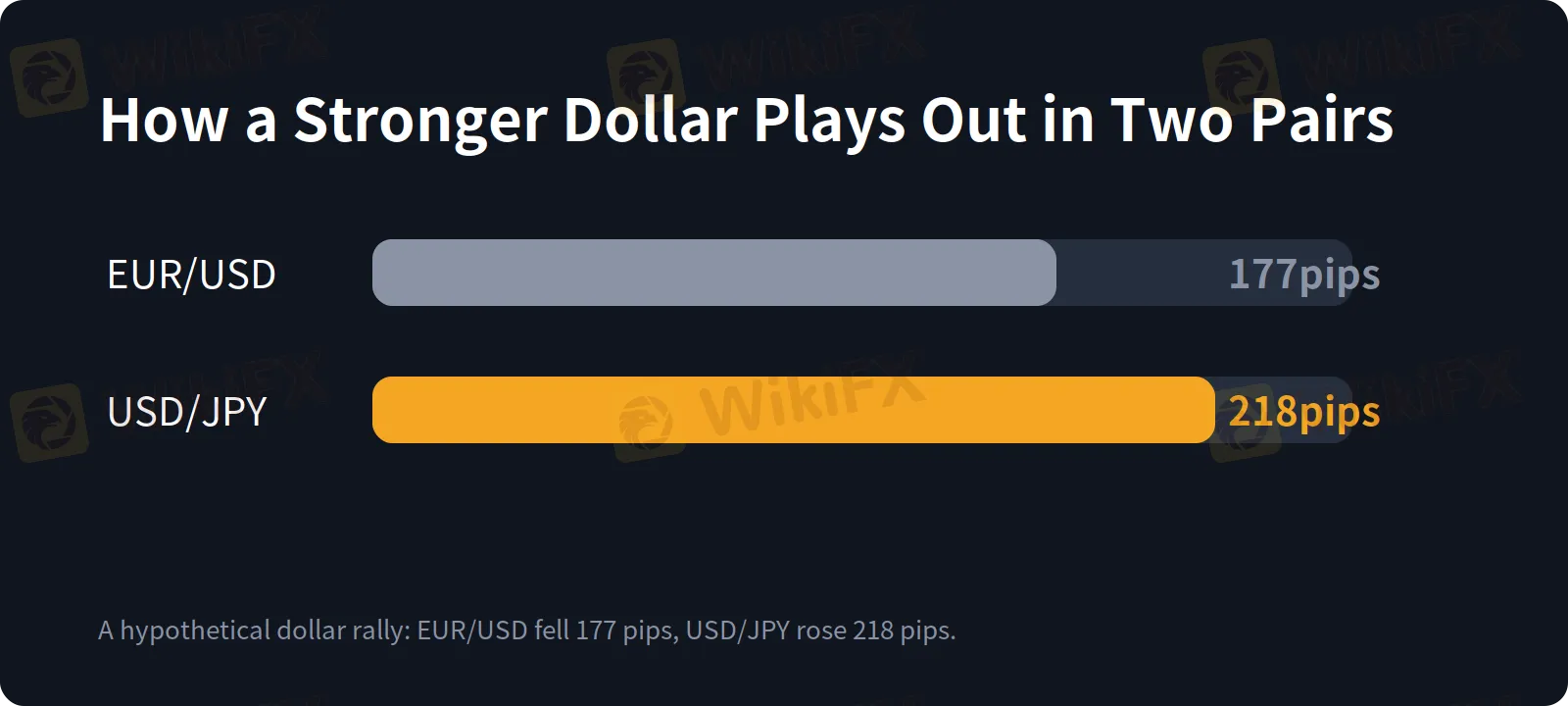
Hypothetical illustration. Actual market reactions vary.
What Beginners Often Get Wrong
- Mistake 1: “If the dollar rises, all my pairs go down.” If you hold a USD/JPY long position, you actually benefit from a stronger dollar. The effect depends on whether USD is the base or the quote.
- Mistake 2: “Cross pairs are immune to the dollar.” EUR/JPY does not contain USD, yet it is influenced indirectly. If the dollar strengthens, both the euro and yen may weaken against the dollar, but EUR/JPY could stay flat if they weaken at similar speeds. Understanding the relative strength is more important than just watching the dollar.
- Mistake 3: “The dollar index covers everything.” The US Dollar Index (DXY) measures the dollar against a basket of six major currencies, with the euro holding a 57.6% weight. Because of this, DXY and EUR/USD often move in opposite directions. A weak euro pushes DXY higher, even if the dollar is steady against the yen. Many beginners watch DXY and mistakenly assume it reflects dollar strength against emerging market currencies like the Indian rupee or Philippine peso. In reality, those pairs are driven by local economic factors as much as by global dollar shifts.
The dollars dominance in forex is undeniable, but it is not magic. It works through a clear set of quoting conventions and economic fundamentals. Once you grasp that the same dollar movement can push EUR/USD lower and USD/JPY higher, you have a framework to read the charts with more clarity. Remember: the dollar is a powerful force, but not every pair dances to its tune in the same way.
ڈس کلیمر:
یہ مضمون صرف مصنف کی ذاتی رائے پر مبنی ہے، یہ پلیٹ فارم کی سرمایہ کاری کی مشورہ نہیں ہے۔ پلیٹ فارم مضمون کی معلومات کی درستگی، مکملیت اور بروقت ہونے کی کوئی ضمانت نہیں دیتا، اور مضمون کی معلومات پر اعتماد یا استعمال سے ہونے والے کسی بھی نقصان کی ذمہ داری قبول نہیں کرتا۔
