

عالمی بروکر ریگولیشن چیک کرنے والا ایپ
WikiFX
اردو
简体中文
繁體中文
English
Pусский
日本語
ภาษาไทย
Tiếng Việt
Bahasa Indonesia
Español
हिन्दी
Filippiiniläinen
Français
Deutsch
Português
Türkçe
한국어
العربية
اردو


Promised 6% Monthly Returns, 10 Investors Lost Rs 1.2 Crore

WikiFX
|


خلاصہ۔:Naupada police in Thane, Maharashtra, have registered a case against the proprietor of two financial investment firms for allegedly cheating 10 investors of Rs 1.2 crore between 2022 and 2024. The accused promised monthly returns of 5 to 6 per cent through share and forex trading and used an agent network to recruit clients.
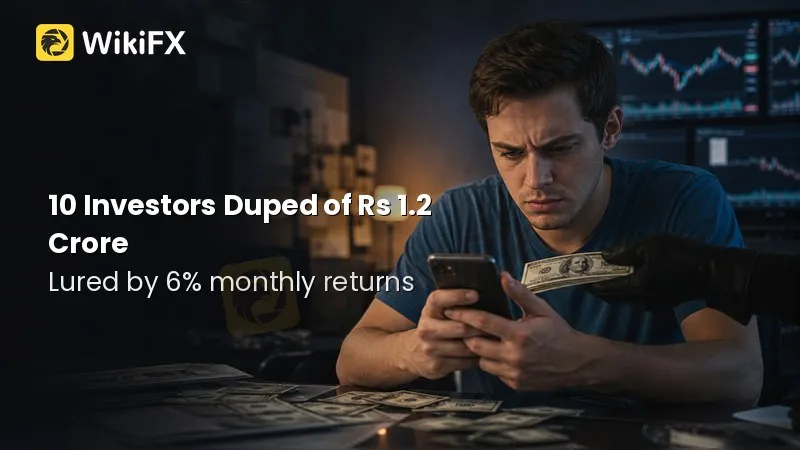
A proprietor of two financial investment firms in Thane, Maharashtra, has been booked by the Naupada police for allegedly cheating 10 investors of Rs 1.2 crore. The accused promised lucrative returns through share and foreign exchange trading, only for investors to lose their money in what police are now investigating.
The case, registered on July 27, 2026, highlights how retail investors were drawn into schemes that dangled unrealistically high monthly payouts, a pattern that regulators and law enforcement agencies across India have repeatedly warned against.

How the Scheme Unfolded
Between 2022 and 2024, the accused approached potential investors by claiming that his two firms were actively engaged in share and foreign exchange, or forex, trading. Forex trading refers to buying and selling currencies on global markets, often marketed to retail investors as a path to quick profits.
The pitch was simple and seductive: investment plans lasting nearly a year, with guaranteed monthly returns of 5 to 6 per cent. For an investor putting in Rs 10 lakh, that would mean a promised monthly payout of Rs 50,000 to Rs 60,000. That translates to an annualised return far exceeding what any regulated financial product in India could legally guarantee.
The Agent Network
To scale the operation, the accused built an agent-network system. Agents were incentivised to bring in new clients, effectively turning victims into recruiters. This multi-level structure helped the scheme reach at least 10 investors before it collapsed, according to the Naupada police official cited in the case.
Such agent-driven models are a common feature in unauthorised investment schemes. They create a veneer of legitimacy through personal referrals while making it harder for victims to recognise the alleged cheating until the promised returns stop arriving.
What Investors Should Watch For
The Thane case carries several red flags that retail investors can learn to identify. Monthly returns of 5 to 6 per cent are not sustainable in any legitimate forex or equity trading operation. Regulated investment products do not guarantee fixed monthly returns, especially at rates that would compound to over 79 per cent annually.
Investors can protect themselves by verifying whether a firm is registered with the Securities and Exchange Board of India or the Reserve Bank of India before handing over money. Checking official registration databases and comparing contact details against those on a firm's website can help expose clone operations. Requests for upfront fees or promises of guaranteed returns should be treated as immediate warning signs.
The absence of a firm's name from a regulator's warning list does not, on its own, mean the entity is safe. Unregistered operators often only appear on such lists after victims come forward.
ڈس کلیمر:
یہ مضمون صرف مصنف کی ذاتی رائے پر مبنی ہے، یہ پلیٹ فارم کی سرمایہ کاری کی مشورہ نہیں ہے۔ پلیٹ فارم مضمون کی معلومات کی درستگی، مکملیت اور بروقت ہونے کی کوئی ضمانت نہیں دیتا، اور مضمون کی معلومات پر اعتماد یا استعمال سے ہونے والے کسی بھی نقصان کی ذمہ داری قبول نہیں کرتا۔
