Abstract:The Euro just experienced one of its worst weeks in years: versus the US Dollar, since March 2020; versus the Swiss Franc, since January 2015.
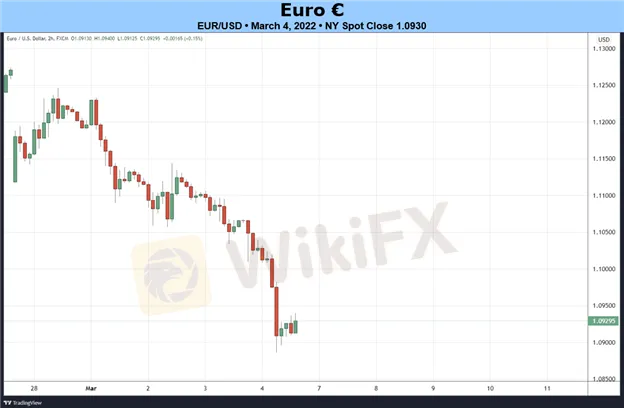
FUNDAMENTAL FORECAST FOR THE EURO: BEARISH
ECB rate expectations are in retreat, and liquidity conditions have deteriorated substantially – neither of which are good for the Euro.
According to the IG Client Sentiment Index, the Euro has a bearish bias heading into mid-March.
EURO WEEK IN REVIEW
It was a brutal week for the Euro as the Russian invasion of Ukraine intensified. Sweeping sanctions by the European Union and the United States, while punishing for the Russian economy, have reverberated back to the Euro as economic risks skyrocket for the Eurozone.
On the low end, EUR/GBP rates lost -1.68%, their worst weekly loss since mid-November 2021. EUR/USD rates dropped by -3.03%, their worst weekly loss since mid-March 2020, the start of the COVID-19 pandemic. EUR/CHF rates, which plunged by -3.98%, experienced their worst weekly decline since January 2015, when the Swiss National Bank removed the floor in the exchange rate.
With commodity prices soaring as energy and grain supplies appear threatened in the short-term, several other EUR-crosses produced even more dramatic losses. EUR/CAD rates slumped by -2.84%, EUR/NZD rates lost -4.68%, and EUR/AUD rates sank by -4.98%.
EUROZONE ECONOMIC CALENDAR TAKES BACK SEAT
The reverberation of the Russian invasion of Ukraine back to the Euro has taken two forms. First, market expectations for a more hawkish European Central Bank have evaporated over the past week (more below). Second, liquidity conditions have deteriorated (as measured by EUR/USD basis swaps), underscoring the greatest demand for US Dollars by financial institutions since the early days of the COVID-19 pandemic.
That said, here are the key events in the week ahead on the Eurozone economic calendar:
On Monday, March 7, January German retail sales are due at 07:00 GMT.
On Tuesday, March 8, January Italian retail sales are set to be released at 09:00 GMT, while the final estimate of 4Q21 Eurozone GDP will be published at 10:00 GMT. February Spanish consumer confidence is due at 16:00 GMT.
On Wednesday, March 9, January Italian industrial production figures will be released at 09:00 GMT.
On Thursday, March 10, the ECB interest rate decision is due at 12:45 GMT while the ECB Christine Lagarde will hold a press conference at 13:30 GMT. The ECBs macroeconomic projections will be released at 14:30 GMT.
On Friday, March 11, final February German inflation rates will be published at 07:00 GMT, February Spanish inflation rates will come out at 08:00 GMT.
For full Eurozone economic data forecasts, view the DailyFX economic calendar.
RUSSIA PROVOKES BEAR MARKET IN ECB HIKE ODDS
Russias invasion of Ukraine is provoking liquidity strains across the global financial sector, with European banks at the center of the storm. There is a non-zero chance that the EU and US sanctions on the Central Bank of Russia provokes a liquidity crunch for European banks that persists for the foreseeable future.
In turn, this may be providing the excuse ECB officials need to justify keep their asset purchase program in place through 3Q‘22, and interest rates lower for longer. We’ll hear from the ECB this week at their March rate decision, which should shine light on their perspective, alongside the release of their updated Staff Economic Projections (SEP).
EUROPEAN CENTRAL BANK INTEREST RATE EXPECTATIONS (MARCH 4, 2022) (TABLE 1)