Abstract:Russia is preparing against the threats of cyberattacks and asked all state-owned websites to move to locally operated domain name systems before March 11. Additionally, they have been ordered to erase all Java script codes downloaded from foreign sources, which are mostly ad services and complicate the password policies.

An unverified order shows that Russia ordered firms to move to local domains and servers.
Foreign technology and infrastructure companies are also cutting ties with Russia.
Moreover, Belarusian media Nexta shared the copies of an order that asked all Russian businesses to migrate their servers and domains to Russia-controlled infrastructure providers. This step might be the beginning of preparations for disconnecting Russia from the global internet.
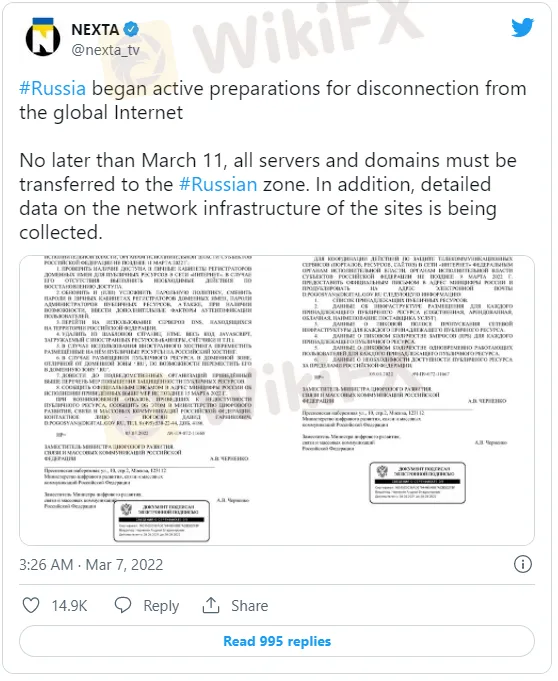
However, in a report by the Russian daily Kommersant, the Ministry of Digital Development denied the government's move to block Russian access to the internet.
It said that the order is now only limited to the government websites and has been taken to prepare the countrys internet infrastructure against any external disconnection and cyber threats.
“We are preparing for various scenarios to ensure that Russian resources are available to citizens. The telegram for government agencies outlines a set of simple cyber hygiene recommendations that will help to organize work more effectively to protect our resources from malicious traffic, keep services running and control over domain names,” the Ministry said (translated from Russian).
However, the report added that the Russian government is still open to issuing such an order to companies, primarily to circumvent the external sanctions.
Attack on the Internet Infrastructure
The Russian internet infrastructure took a heavy hit with western sanctions. Though the western governments did not directly target the internet infrastructures, many companies are self-sanctioning Russian services either from the fear of actions against them or for moral reasons.
Microsoft and Apple banned all of their services in Russia. Additionally, internet backbone provider, Cogent Communications cut its ties with Russian clients that include the state-backed telecom giant Rostelecom and Russian search engine Yandex. In addition, it was serving MegaFon and VEON, two of Russias largest mobile carriers.
Cogent said that it has taken the move in response to European Unions ban on Russian digital media. Though the move will not disconnect Russia completely from the internet, it will definitely make accessing websites from Russia slower.
Meanwhile, many advocates of the free and independent internet raised their voices against the growing hostility of western companies.
“I am very afraid of this,” Internet Protection Societys Executive Director, Mikhail Klimarev told Washington Post.
“I would like to convey to people all over the world that if you turn off the Internet in Russia, then this means cutting off 140 million people from at least some truthful information. As long as the Internet exists, people can find out the truth. There will be no Internet — all people in Russia will only listen to propaganda.”
Preparing for Censorship?
But, the western service providers are not the only ones to block Russian services. The Russian government itself banned Facebook and throttled other foreign social media platforms.
Also, the country is advancing its internal internet censorship technology that might work on par with Chinas notorious The Great Firewall.