Abstract:The cryptocurrency market is highly fragmented. Which type of venue, among hundreds of exchanges and OTC desks, provides the “best execution” for institutions and crypto-related businesses?

Let us have a closer look at the crypto market structure.
Let us have a closer look at the crypto market structure.
The cryptocurrency market has skyrocketed in popularity in recent years, giving traders a wide range of options for betting on market values. According to Coinmarketcap.com, one of the top publicly-traded cryptocurrency exchanges in the world, there are more than 450 centralized crypto exchanges (CEX).
Fortunately, getting started with cryptocurrency trading isn't as difficult as it may appear. Simply create an account, have it verified, and deposit your funds, and you'll be ready to trade.
In cryptocurrency markets, prices can fluctuate quickly. Liquidity, or the ease with which an asset can be bought or sold at a consistent price on a given market, is critical to any type of trading. However, traders may find substantial price discrepancies and spreads across multiple platforms in the fragmented cryptocurrency market, particularly for altcoins.
When trading large volumes on a single exchange, financial institutions may encounter liquidity issues. According to Crypto Trading Report 2022 by PWC Switzerland & Finery Markets, institutions typically trade digital assets on 5 or more exchanges in more than half of the cases in order to mitigate the risks associated with liquidity issues.
However, having to investigate each venues API, maintain the associated technical support, and manage cash balances on each exchange can be a very time-consuming process for insitutions.
Institutions have increasingly preferred over-the-counter (OTC) trade executions over centralized exchanges in recent years due to improved liquidity and flexibility.
Over-the-counter (OTC) trading provides a broader range of options than centralized exchanges. Furthermore, trades can be executed between two parties via voice or electronically. This provides investors discretion and access to liquidity outside of the regular market.
OTC desks aid in the execution of larger trades without causing market disruption. This is due to the fact that they are connected to multiple venues and have buyer-seller networks where both sides conduct business directly with one another.
Not only that, but OTC trading can help to eliminate the bureaucratic layers that can stymie larger transactions.
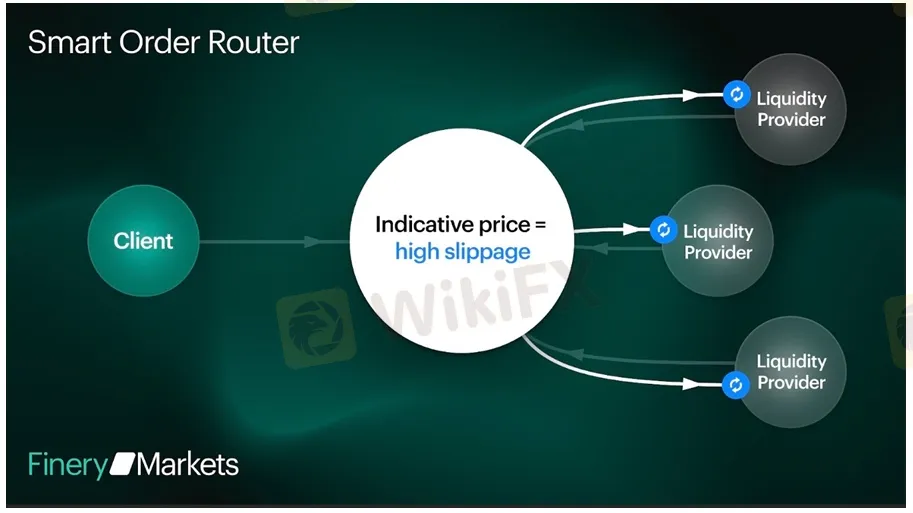
Larger companies can trade on OTC desks and exchanges at the same time if they require extra liquidity. The Smart Order Router (SOR) algorithm analyzes exchanges and OTC desks to determine the best route to execute deals. The SOR system was developed as a response to market fragmentation. However, there is a lack of transparency in the execution process in this model.
SOR trade executions can lead to issues like slippage, which is the discrepancy between a trade's expected price and the price at which it is executed. Market volatility, or “last looks,” is frequently to blame for these unexpected prices. Last look means that an OTC desk or a Liquidity Provider (LP) may hold a request for a period of time or reject a trade.
Despite the fact that Smart Order Routers is a sophisticated software solution, it has no influence over the quality of a trade execution. Thats due to the fact that SORs are dependent on the venues to which the orders are routed.
Large orders, for example, can be split between different liquidity sources, such as exchanges and OTC desks. The OTC desk may hold the order for a period of time, execute the trade at the quoted price, slightly delay execution, or decline the order. Although not all cryptocurrency traders are aware of this, it can result in high execution costs.
Smart-Order-Routing execution model
Is there a way to eliminate slippage and improve the quality of execution?
Multi-Dealer execution venues are a type of technology that allows a client to connect to many liquidity providers over a single connection. OTC desks feed their firm quotes straight to an execution venue in this example, allowing clients to trade against firm liquidity. A client can choose which OTC desk they want to trade with. Multi-Dealer execution venue is essentially a B2B marketplace for OTC desks and customers.
The multi-dealer execution venue concept encourages OTC desks to offer institutional clients the best prices (brokers, banks, hedge-funds, payment service providers, etc).
Finery Markets was first-to-market to offer this type of solution in 2019, with “zero” Takers' fees, tight spreads, and predictable execution during market volatility.
Multi Dealer Execution venue model

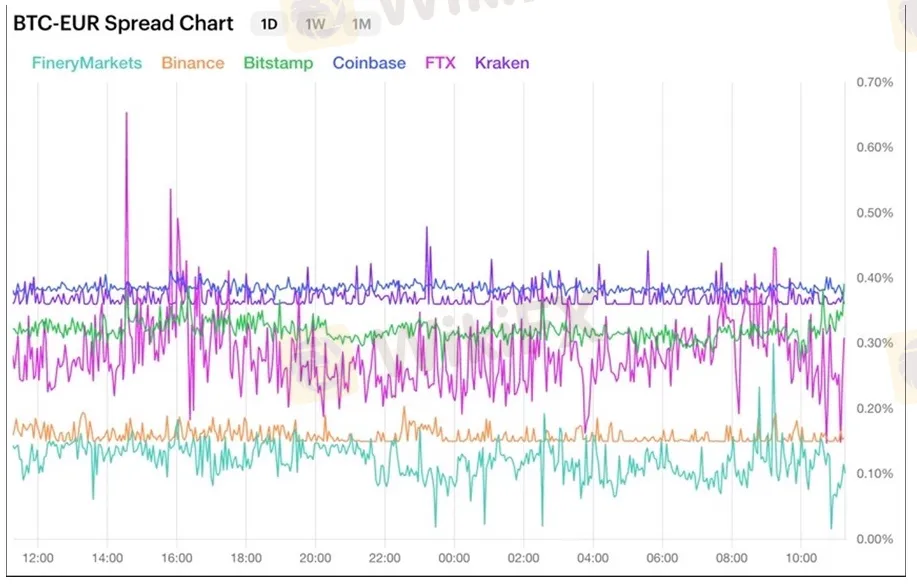
To get better execution, a client must delve deeper into the market structure and understand the distinctions between various venues. Institutional investors can use Markets Pulse to compare prices across multiple exchanges with aggregated firm OTC liquidity and select a better fit for its execution.
Bid-ask spreads on ETH-BTC on major exchanges on the 21 March 2022