Abstract:Update: Gold (XAU/USD) is observing a minor correction after a stellar reversal below $1,900.00 as investors got lured to the value bet.
Gold is on the bid in late New York and the DXY is pressured.
The Ukraine crisis is intensifying as hopes of a cease-fire anytime soon are dashed.
XAU/USD bulls are looking to the month-end close for prospects of a continuation next month.
The Russia-Ukraine peace talks on Tuesday brought an intensified selling for the safe-haven assets. However, the gold price has recovered a significant portion and is hovering near $1,930.00. The responsive buying in the gold prices banks upon fading optimism over the negotiations between Moscow and Kyiv.
Meanwhile, the US dollar index (DXY) has been dragged below 98.00 amid poor performance from the annualized Gross Domestic Product (GDP) (Q4) numbers and Automatic Data Processing (ADP) Employment Change. The DXY is trading lackluster around 97.80 as the mega event of the US Nonfarm Payrolls (NFP) is due later this week, which will guide the likely monetary policy action from the Federal Reserve (Fed) in May. Investors are also focusing on 10-year and two-year US Treasury yields amid uncertainty over the yield inversion as the Fed is going to elevate the interest rates this year swiftly.
End of Update
At $1,933.54, the gold price is 0.72% higher on the day with XAU/USD travelling between a low of $1,916.01 and $1,938.62 the high so far. Gold prices rose and have been supported by a softer US dollar and renewed doubts about the possibility of a ceasefire between Russia and Ukraine.
The US dollar (DXY) fell 0.6% to nearly a two-week low despite peace talk hopes between Ukraine and Russia deteriorating again. Gold prices fell by as much as 1.8% after Russia pledged to cut down on military operations around Kyiv and in northern Ukraine in peace talks on Tuesday, but the precious metal pared most of the losses to settle just 0.2% lower for the day as sceptics remained in the room.
Ukraine crisis intensifies
Concerns were solidified when, although the Kremlin on Wednesday welcomed that Kyiv had set out its demands for an end to the conflict in Ukraine in written form, it said there was no sign of a breakthrough yet. Ramzan Kadyrov, who is a powerful head of the Russia's republic of Chechnya, said on Wednesday that Moscow would make no concessions in its war in Ukraine and that Kremlin negotiator Vladimir Medinsky had been wrong to suggest otherwise. Polish Deputy Prime Minister also crossed the wires and stated that Russia is preparing for a new attack in Ukraine and all indications are that we are facing a long war, Aljazeera Tweeted.
On Wednesday, Russian forces bombarded the outskirts of Kyiv and the US administration had warned on Tuesday they were sceptical of Russias vow to curtail its military assault on Ukraine, ending the day with a note of caution after hours of peace talks between the two sides appeared to make some headway.
However, traders will be watching closely to see if there can still be progress following yesterday's talks. After all, the Ukrainian presidential advisor Mykhailo Podolyak said that there had been ''successful enough for a possible meeting between Putin and Zelensky.'' Podolyak added, we have documents prepared now which allow the presidents to meet on a bilateral basis,.''
Markets have also been keeping a close tab on the US 2-year/10-year Treasury yield curve, which briefly inverted on Tuesday. The bond markets monitoring for tightening by the Federal Reserve has resulted in an inverse of the curve, signalling to markets that a recession could be on the way.
''With haven flows remaining robust, the risk of buyers being forced to offload in a vacuum alongside potential CTA liquidations have diminished for now, with key downside CTA triggers sitting in the $1870/oz region,'' analysts at TD Securities argued.
''Nonetheless, gold traders will also have to contend with macro outflows associated with a hawkish Fed as rates markets are readying for the Fed to deliver a hawkish surprise to markets,'' the analysts added. ''With that said, while geopolitical tensions and yield curve recession signals re-ignite investor interest in gold, downside risks still remain amid a hawkish Fed backdrop and as negotiators continue to work towards a ceasefire.''
Gold technical analysis
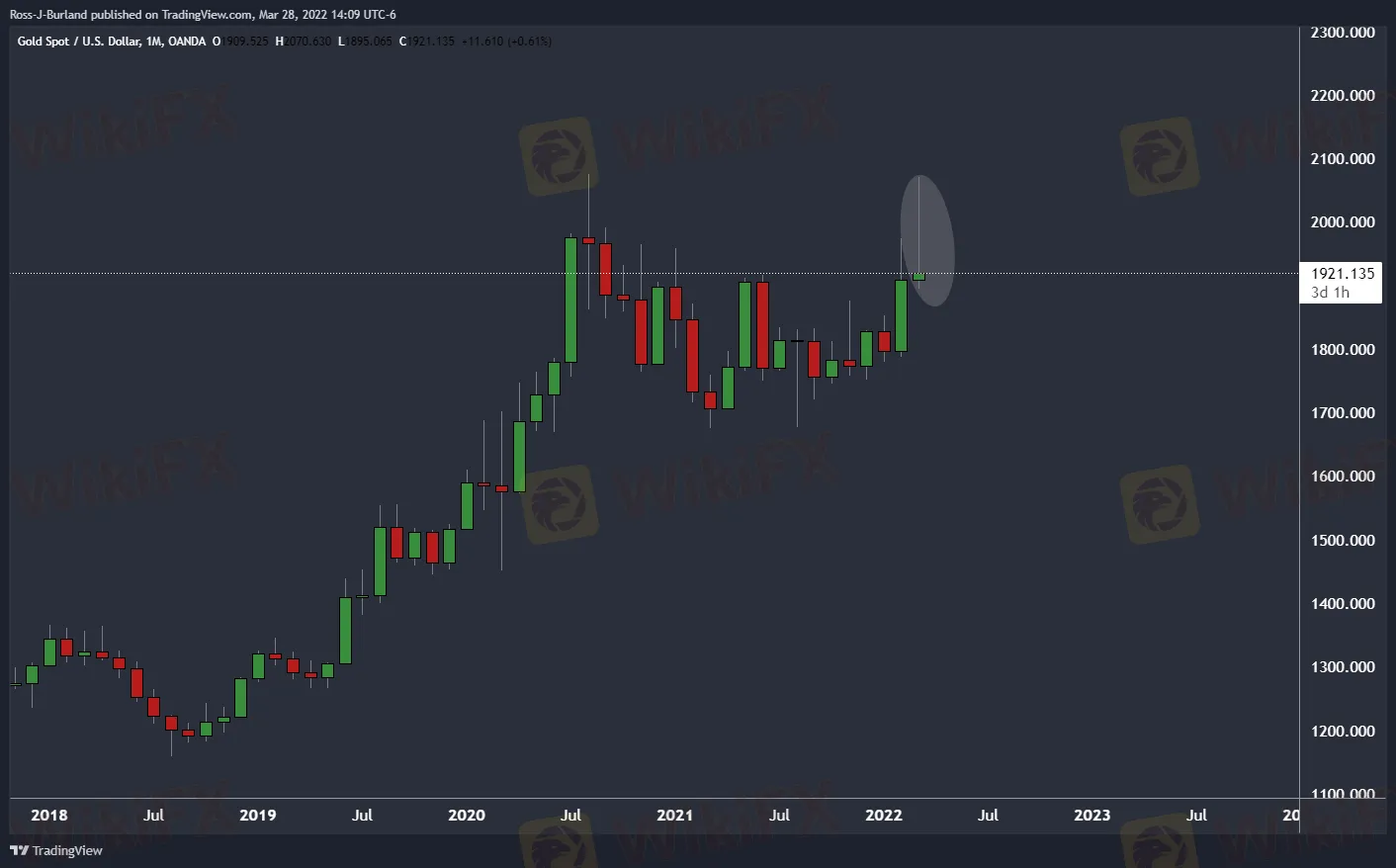
Chart of the Week: Gold is moulding a bullish close for the month
We are in the last week of the month and the start of a new quarter could print a bullish prospect on the monthly chart, as illustrated below: