Abstract:Bonds slipped, the dollar edged higher and Asia’s stockmarkets made a shaky start to the second half on Friday, as investors grow increasingly nervous about the global economic outlook.
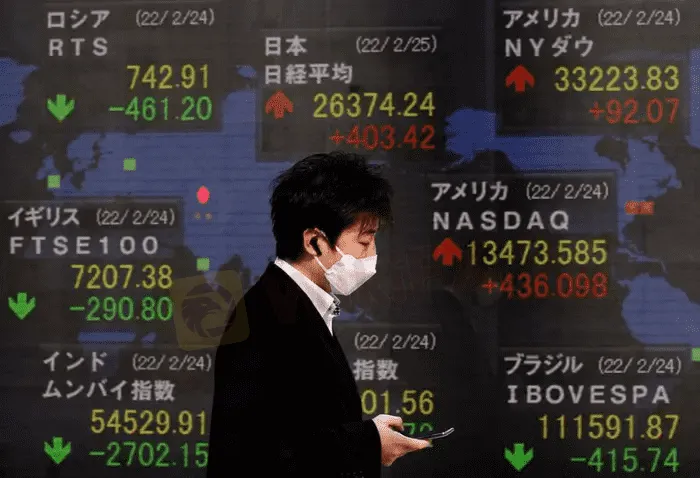
Stocks fell and the dollar rose on Friday, beginning the second half of the year much as the first one had ended, only this time with bonds rallying for a change as investors have shifted from worrying about inflation to fearing a global recession.
S&P 500 futures fell 1%. MSCIs index of Asia-Pacific shares outside Japan fell 1%, with the heaviest fall in Taiwan where the growth-sensitive benchmark index slid 3% to its lowest since late 2020.
Japans Nikkei fell 2%. The Australian and New Zealand dollars each fell 1% to two-year lows. U.S. Treasuries rose, driving benchmark 10-year yields to one-month lows. [.T] [US/]
Demand-tracking commodities such as oil and copper were under pressure, leaving Brent crude futures at a one-week low of $108.87 a barrel. [O/R][MET/L]
“Capitulation is the wrong approach but earnings pressure will follow to match the macro downgrades,” said George Boubouras at K2 Asset Management in Melbourne.
“We are pricing in a recession phase and bonds will now outperform … low correlation between bonds and equities is what should happen – unlike the first half of calendar 2022.”
The S&P 500 closed out its worst first-half since 1970 on Thursday and the Treasury market took such a beating that Deutsche Bank estimated the halfs performance was the poorest in more than two centuries.
It has been hints of peaking inflation and signs of weak growth that have started steadying bond markets. Two-year Treasuries are on course for their best week since markets pandemic meltdown of March 2020 as traders wind back hike bets.
The two-year yield is down almost 14 basis points this week to 2.904%. The 10-year yield is down about 15 bps on the week to 2.9667%.
Fed funds futures, which a few weeks ago were priced for rates to hit 4% next year, are now showing that markets expect rate cuts by the middle of 2023 and a peak below 3.5%.
China bright
The dollar had its best quarter since 2016 for the three months to the end of June as U.S. yields rose. Economic uncertainty has kept it supported even as yields have retreated.
“Its safe-haven demand,” said Khoon Goh, head of Asia research at ANZ Bank in Singapore.
The dollar had its best quarter since 2016 for the three months to the end of June and was back testing highs on Friday.
Other safe-haven currencies such as the Japanese yen and the Swiss franc also drew investors. The Australian dollar fell through support at $0.6850 and was last down 1.1% at $0.6824. The kiwi slid 1% to %0.6178. [AUD/]
The yen rose about 0.5% to 135.08 per dollar and a little further to 141.31 per euro.
A string of surveys on Friday showed China emerging as an outlier. Factory activity bounced solidly in June against slowdowns in Japan and South Korea and contraction in Taiwan.
Markets are also bouncing and though the Shanghai Composite and blue-chip CSI300 edged about 0.3% lower on Friday, they are each set to log five straight weeks of gains.
Hong Kong‘s markets were closed for a holiday, and the city was focused on Chinese President Xi Jinping’s visit.
The yuan slipped with the broader market to 6.7136 per dollar. Gold has been weighed by the stronger dollar and U.S. yields and was flirting with $1,800 an ounce.
Bitcoin, which suffered its biggest quarterly drop on record over the three months to the end of June, fell 3% to $19,375 on Friday.