


UK Retail Sales July 2026 Fall 0.5%: What the Result Means for GBP
UK retail sales fell 0.5% in July 2026, while the three-month measure rose 1.1%. See the ONS details and what the mixed result may mean for GBP.
Original

简体中文
繁體中文
English
Pусский
日本語
ภาษาไทย
Tiếng Việt
Bahasa Indonesia
Español
हिन्दी
Filippiiniläinen
Français
Deutsch
Português
Türkçe
한국어
العربية
اردو




Abstract:Investors in the country's economy have pleaded with the federal government to turn its attention back to the non-oil export sector, which has tremendous potential to grow the economy.

Investors in the country's economy have pleaded with the federal government to turn its attention back to the non-oil export sector, which has tremendous potential to grow the economy.
In order to create an environment where businesses might flourish in Nigeria, they argued that the country's regulatory bodies needed to be completely reoriented.
They also urged the Nigerian Export-Import Bank (NEXIM), the nation's principal non-oil export finance institution, to launch a specific fund to support the industry.
They bemoaned the fact that businesses from other countries with quick regulatory systems would then bring the identical products into the country to market while processes for product certifications in Nigeria took so long.
They complained to Daily Independent about the “imposition of the Nigerian Autonomous Foreign Exchange Fixing (NAFEX) rate on export proceeds, which restricts their access to foreign exchange and their inability to use their export proceeds,” and that the export flow in terms of payment and verification is “extremely cumbersome.”
In addition to a stable macroeconomic climate and policies like tariffs, quotas, subsidies, and non-tariff barriers that protect emerging industries so they can grow and produce jobs in the future, they promoted more responsible spending and greater transparency.
Recall that Professor Yemi Osinbajo, Vice President SAN, noted that there is a problem “if people who want to export cannot export due to what seems like too many regulations” after receiving a report from an Ad-Hoc Committee of the Presidential Enabling Business Environment Council, PEBEC, on Agro-Export and the presentation of a National Action Plan 7.0 at the Presidential Villa.
The regulatory requirements are too numerous. Regulation overkill stifles productivity. We need to review our regulatory procedures once more. Overregulation is destroying the economy. Investments are destroyed. After months, an agricultural exporter cannot export perishable produce. He bemoaned the fact that businesses from other countries with quick regulatory systems would then bring the same products into the country to sell while processes for product certifications in Nigeria took so long.
The VP noted, “Because our certification processes are slow, others from outside nations (from neighbors based on an ECOWAS agreement) with speedier processes can bring their products and sell here, while our own enterprises are still in line with regulatory bodies.”
It should be recalled that the PEBEC Secretariat had previously delivered a report of the Presidential Enabling Business Environment Council on Agro-Ad-Hoc Export's Committee, in which it was, among other things, revealed that: Exporters complained about the “imposition of the NAFEX rate on export proceeds, which limits their access to foreign exchange and their incapacity to utilize their export proceeds. The exportation flow is particularly onerous in terms of payment and certification. (For instance, money held in an exporter's account cannot be used to pay for export freight); Pre-shipment Inspection Agencies performed ”several physical cargo examinations,“ and there were ”many and occasionally overlapping paperwork requirements from governmental regulatory organizations.
The Council decided to approve an Agro-Export Action Plan to address the issue as well as a 60-day National Action Plan 7.0 that carries on the Buhari administration's changes to make it easier for businesses to operate. The start date for the Plan is February 7, 2022.
In an exclusive interview with Daily Independent, Dr. Muda Yusuf, economist and CEO of the Centre for the Promotion of Private Enterprise (CPPE), stated that the non-oil export sector, which has enormous potential to expand the economy, has been negatively impacted by rising production and operating costs for businesses, which have resulted in shrinking profit margins, declining sales, declining turnover, and weak manufacturing capacity utilization.
In order to facilitate significant investment inflow into the nation this year, he also called for the repositioning of the electricity sector and the resolution of lingering downstream oil sector difficulties.
He emphasized that excessive regulation discourages investment and that an agricultural exporter cannot ship perishable goods after months have passed.

Disclaimer:
The views in this article only represent the author's personal views, and do not constitute investment advice on this platform. This platform does not guarantee the accuracy, completeness and timeliness of the information in the article, and will not be liable for any loss caused by the use of or reliance on the information in the article.
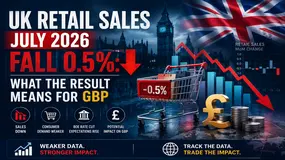
UK retail sales fell 0.5% in July 2026, while the three-month measure rose 1.1%. See the ONS details and what the mixed result may mean for GBP.
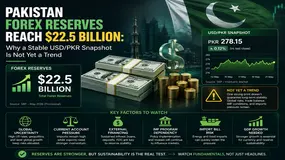
Pakistan forex reserves stood at $22.506 billion on 13 August 2026, while the SBP dashboard showed a USD/PKR mark to market rate of 277.5713 on 20 August. This article separates the SBP forex reserves facts from predictions about the Pakistan rupee and the forex market Pakistan.
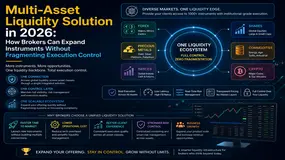
A multi-asset liquidity solution can help a broker support FX, CFDs, commodities, and indices through a more unified operating model. But adding asset classes can also create fragmented symbols, pricing, routing, margin rules, records, and client messages if controls are not designed first. This 2026 guide explains how a multi asset liquidity provider, forex CFD liquidity setup, commodity liquidity provider, and indices liquidity provider fit into a broker-owned execution service. It outlines the due-diligence questions, shared-control model, cost drivers, and 90-day implementation plan that help teams expand without making the execution chain harder to explain. The aim is not to promise deeper liquidity or better trading outcomes. It is to create evidence that a broker can supervise market access, trace order events, reconcile costs, and communicate consistently to the relevant clients when conditions are difficult.

Gold surged above $4,500 after the US Treasury expanded its purchases of longer-dated government bonds, pushing yields and the dollar lower. But this was not debt forgiveness or Federal Reserve money printing—it was a liquidity operation that exposed a much bigger fear: America may be finding it increasingly difficult to live with market-driven interest rates.
WikiFXWikiFXWikiFXWikiFXWikiFXWikiFXWikiFXWikiFXWikiFXWikiFX