


FOMC Minutes Today: 3 USD and Gold Scenarios Traders Should Prepare For
The Fed releases the July FOMC minutes on 19 August 2026. Here are three USD and gold scenarios, confirmation signals, and a practical risk checklist for traders.
Original

简体中文
繁體中文
English
Pусский
日本語
ภาษาไทย
Tiếng Việt
Bahasa Indonesia
Español
हिन्दी
Filippiiniläinen
Français
Deutsch
Português
Türkçe
한국어
العربية
اردو




Abstract:The euro increased against a basket of key competitors in European commerce, extending gains against the dollar for the second day and moving in the expectations by the European Central Bank.
· The dollar continues to rise before US inflation data
The euro increased against a basket of key competitors in European commerce, extending gains against the dollar for the second day and moving in the expectations by the European Central Bank.
After the Federal suspending policy tightening and ending the current cycle, the dollar's losses continued, and investors are now expecting information on US banking lending levels.
Following a 0.1% gain on Thursday, the EUR/USD gained 0.25 percent to 1.1050, with a session low of 1.1014—the third gain in four days as a result of US financial pressure.
ECB
Inflation expectations is still high, European Central Bank President Christine Lagarde stated at the news conference following the ECB meeting.
Consequently, the ECB made the decision to increase interest rates by 25 basis points to 3.75%, the highest level since 2008.
It is evident that after Lagarde stated that everyone agreed with more room to cover were necessary.
Lagarde pointed out that some members went so far as to request a rate increase of 0.5% this month.
Lagarde added that the choice made today was ultimately approved by all parties in the context of a common effort to fight inflation.
Rates in Europe
Markets are still pricing in June and July to deal with persistent inflation.
Deutsche Bank has kept its forecast for European interest rates at 4.25% this summer.
A dollar
In relation to a basket, the dollar index declined 0.2% on Monday, extending losses for the second day.
After increasing interest rates seven times in 2022—in March, May, June, July, September, November, and December—the current round of policy tightening was coming to an end.
Now that the US Treasury Secretary has warned that the US government would not be able to pay its bills by June 1st, investors are keeping an eye to negotiate the US debt ceiling situation.
THE DOLLAR CONTINUES TO RISE BEFORE US INFLATION DATA
Due to growing demand and the likelihood of another Federal Reserve rate hike in June, the dollar increased for a second session against a basket of key rivals in European trade.
Investors are currently anticipating crucial US inflation data for April in order to revalue these odds and determine the severity of inflationary pressures.
An index
After climbing 0.1% yesterday, the dollar index increased by 0.3% to 101.69, with a session low of 101.35. This is the second gain in three days as a result of positive US labor market data from April.
The odds of no policy change at the Federal Reserve's June meeting are 88%, with a 12% probability of a 0.25% rate hike, according to US RATE Markets.
Data on Inflation
After recent data showed that consumer inflation expectations were inconsistent in April, investors are now waiting for significant US data in April to determine the future.
Credit Requirements
Recent US data indicated that credit conditions are stronger than anticipated, which allayed fears about the US banking industry.

Disclaimer:
The views in this article only represent the author's personal views, and do not constitute investment advice on this platform. This platform does not guarantee the accuracy, completeness and timeliness of the information in the article, and will not be liable for any loss caused by the use of or reliance on the information in the article.
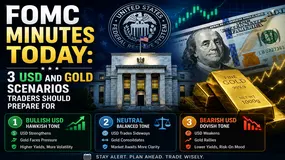
The Fed releases the July FOMC minutes on 19 August 2026. Here are three USD and gold scenarios, confirmation signals, and a practical risk checklist for traders.

A Prime of Prime forex arrangement can help a broker access trading relationships, credit intermediation, technology connectivity, and liquidity aggregation that may otherwise be difficult to obtain directly. But the label does not prove direct bank access, executable depth, or a particular execution outcome. This 2026 guide explains what a forex Prime of Prime, PoP liquidity provider, prime brokerage forex service, and forex prime broker proposal can mean in practice; where the credit and order-routing chain must be documented; how to test pricing, limits, rejects, records, and resilience; and which commercial terms create hidden operating cost. Use the comparison framework, red-flag list, and 90-day launch plan to assess fit for your client mix and risk model. The objective is a controllable execution dependency with traceable evidence, not a marketing claim about institutional access.
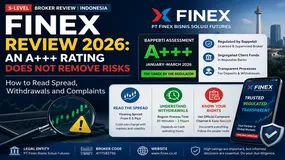
FINEX review 2026 for readers comparing an Indonesia forex broker: understand what Bappebti's A+++ rating does and does not show, then check floating spreads, withdrawals, segregated accounts and the complaint route for PT Finex Bisnis Solusi Futures.
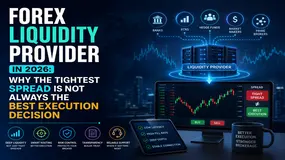
Choosing a forex liquidity provider is not a search for the lowest displayed spread or the longest provider list. It is a broker decision about pricing integrity, depth, routing, credit, reporting, incident response, and client communication. This 2026 guide explains how a forex LP, FX liquidity provider, or liquidity provider forex arrangement fits into a broker’s execution chain; what to test before onboarding; why a “best forex liquidity provider” claim cannot replace due diligence; and how to compare cost beyond commission. Use the execution-quality scorecard, provider questions, routing scenarios, and 90-day onboarding plan to assess whether a liquidity relationship can support your actual client mix, instruments, risk model, and jurisdiction. The goal is not to make a universal ranking. It is to build evidence that your broker can explain, supervise, reconcile, and recover its execution service when market conditions are difficult.
WikiFXWikiFXWikiFXWikiFXWikiFXWikiFXWikiFXWikiFXWikiFXWikiFX