


FOMC Minutes Today: 3 USD and Gold Scenarios Traders Should Prepare For
The Fed releases the July FOMC minutes on 19 August 2026. Here are three USD and gold scenarios, confirmation signals, and a practical risk checklist for traders.
Original

简体中文
繁體中文
English
Pусский
日本語
ภาษาไทย
Tiếng Việt
Bahasa Indonesia
Español
हिन्दी
Filippiiniläinen
Français
Deutsch
Português
Türkçe
한국어
العربية
اردو




Abstract:On June 1, Binance Australia, a popular cryptocurrency exchange platform, made a significant announcement regarding its services in the country.
Introduction
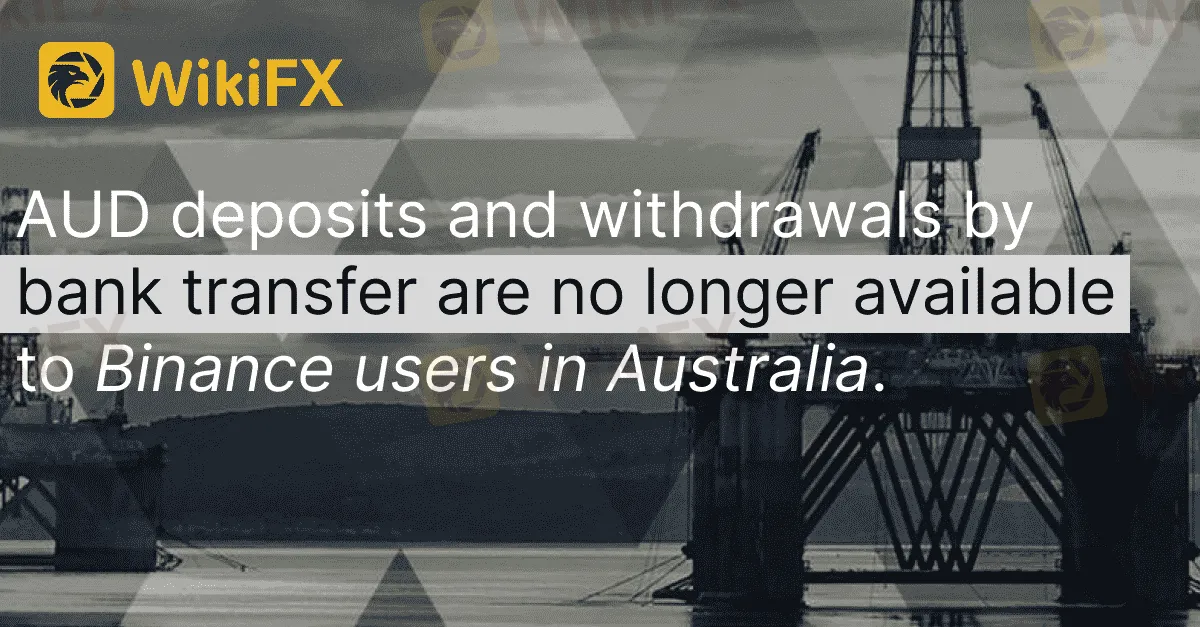
On June 1, Binance Australia, a popular cryptocurrency exchange platform, made a significant announcement regarding its services in the country. The company revealed that Australian Dollar (AUD) deposits and withdrawals via bank transfer would no longer be available to Binance users in Australia. Additionally, Binance Australia discontinued all AUD trading pairs as of the same date. This decision has raised concerns among cryptocurrency traders and has prompted a need for alternative solutions within the Australian market.

Ceasing AUD Deposits and Withdrawals
Binance Australia's decision to terminate AUD deposits and withdrawals by bank transfer has undoubtedly caught the attention of its users. This move implies that users will no longer be able to directly deposit or withdraw Australian Dollars using traditional banking methods. Instead, Binance Australia users will have to explore alternative options to transfer funds to and from their Binance accounts.
The exact reasons behind Binance Australia's decision to cease AUD deposits and withdrawals by bank transfer have not been explicitly stated. However, regulatory concerns and compliance with local financial laws may be contributing factors. As cryptocurrency regulations evolve globally, companies like Binance are continuously adjusting their services to align with regulatory frameworks.
Discontinuation of AUD Trading Pairs
In addition to the halt of AUD deposits and withdrawals, Binance Australia also discontinued all AUD trading pairs as of June 1. This means that users will no longer be able to trade cryptocurrencies directly against the Australian Dollar on the Binance Australia platform. Traders who relied on these pairs for their trading strategies will need to adapt and explore alternative options provided by other exchanges.
Alternative Solutions
While Binance Australia's decision to discontinue AUD deposits and withdrawals by bank transfer and terminate AUD trading pairs may inconvenience some users, the cryptocurrency market in Australia offers a range of alternative platforms and services. Users who wish to deposit or withdraw AUD can explore other local cryptocurrency exchanges that support bank transfers or consider utilizing peer-to-peer trading platforms. Additionally, users can also convert their AUD to stablecoins (cryptocurrencies pegged to fiat currencies) available on various exchanges and trade them against other cryptocurrencies.
It is worth mentioning that Binance Australia's decision may lead to increased competition among local exchanges and potentially foster innovation in the cryptocurrency market. Other exchanges might seize the opportunity to offer more comprehensive services to cater to the needs of Australian users, thus providing a wider range of options for traders and investors.
Conclusion
Binance Australia's recent announcement regarding the cessation of AUD deposits and withdrawals by bank transfer, as well as the discontinuation of AUD trading pairs, marks a notable change in the services offered by the platform in Australia. The decision may be driven by regulatory considerations and the evolving landscape of cryptocurrency regulations. However, despite the inconvenience caused to some users, alternative solutions exist within the Australian cryptocurrency market, including other exchanges and peer-to-peer trading platforms. As the market adapts to this change, it will be interesting to observe how other platforms respond to the demand and fill the gap left by Binance Australia's decision.

Disclaimer:
The views in this article only represent the author's personal views, and do not constitute investment advice on this platform. This platform does not guarantee the accuracy, completeness and timeliness of the information in the article, and will not be liable for any loss caused by the use of or reliance on the information in the article.
The Fed releases the July FOMC minutes on 19 August 2026. Here are three USD and gold scenarios, confirmation signals, and a practical risk checklist for traders.

A Prime of Prime forex arrangement can help a broker access trading relationships, credit intermediation, technology connectivity, and liquidity aggregation that may otherwise be difficult to obtain directly. But the label does not prove direct bank access, executable depth, or a particular execution outcome. This 2026 guide explains what a forex Prime of Prime, PoP liquidity provider, prime brokerage forex service, and forex prime broker proposal can mean in practice; where the credit and order-routing chain must be documented; how to test pricing, limits, rejects, records, and resilience; and which commercial terms create hidden operating cost. Use the comparison framework, red-flag list, and 90-day launch plan to assess fit for your client mix and risk model. The objective is a controllable execution dependency with traceable evidence, not a marketing claim about institutional access.
FINEX review 2026 for readers comparing an Indonesia forex broker: understand what Bappebti's A+++ rating does and does not show, then check floating spreads, withdrawals, segregated accounts and the complaint route for PT Finex Bisnis Solusi Futures.

Choosing a forex liquidity provider is not a search for the lowest displayed spread or the longest provider list. It is a broker decision about pricing integrity, depth, routing, credit, reporting, incident response, and client communication. This 2026 guide explains how a forex LP, FX liquidity provider, or liquidity provider forex arrangement fits into a broker’s execution chain; what to test before onboarding; why a “best forex liquidity provider” claim cannot replace due diligence; and how to compare cost beyond commission. Use the execution-quality scorecard, provider questions, routing scenarios, and 90-day onboarding plan to assess whether a liquidity relationship can support your actual client mix, instruments, risk model, and jurisdiction. The goal is not to make a universal ranking. It is to build evidence that your broker can explain, supervise, reconcile, and recover its execution service when market conditions are difficult.
WikiFXWikiFXWikiFXWikiFXWikiFXWikiFXWikiFXWikiFXWikiFXWikiFX