


FOMC Minutes Today: 3 USD and Gold Scenarios Traders Should Prepare For
The Fed releases the July FOMC minutes on 19 August 2026. Here are three USD and gold scenarios, confirmation signals, and a practical risk checklist for traders.
Original

简体中文
繁體中文
English
Pусский
日本語
ภาษาไทย
Tiếng Việt
Bahasa Indonesia
Español
हिन्दी
Filippiiniläinen
Français
Deutsch
Português
Türkçe
한국어
العربية
اردو




Abstract:Foreign investors pulled $312M from the Philippines in April, a rise from March's $236M, says BSP. However, net inflows were seen over the first four months.
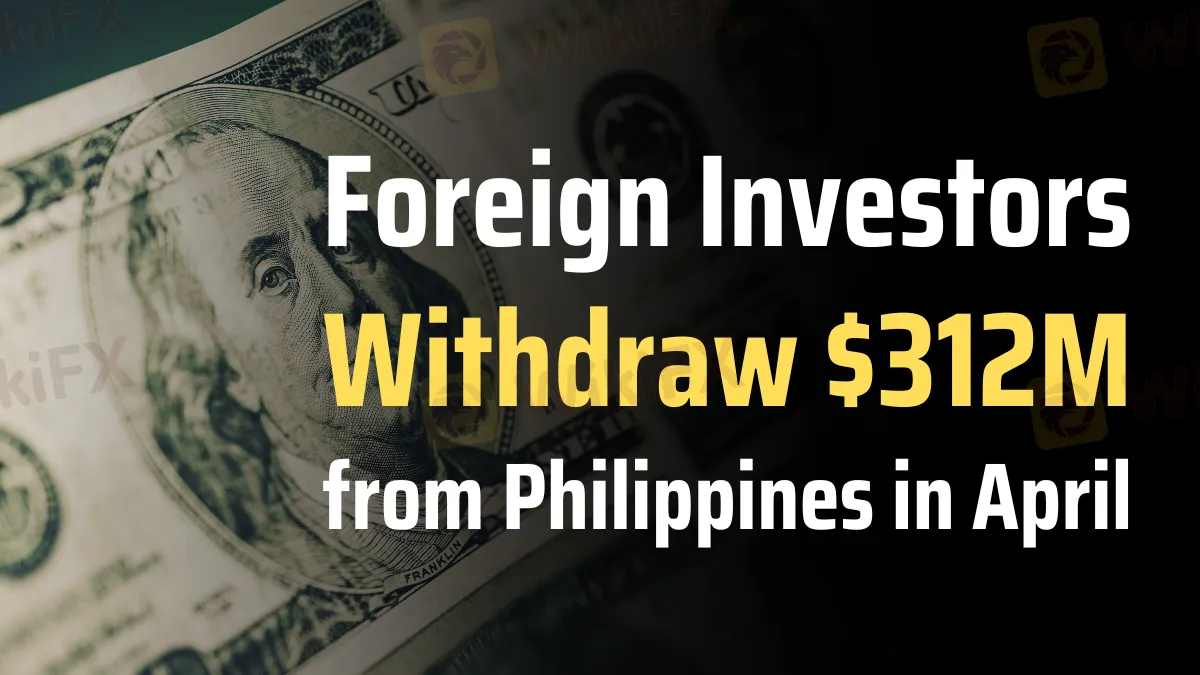
In April 2024, the Philippines suffered a substantial outflow of foreign portfolio investments, sometimes known as “hot money,” with net withdrawals totaling $312 million. This amount, announced by the Bangko Sentral ng Pilipinas (BSP), is up from the $236 million net outflows recorded in March. Despite the monthly rise, the year-on-year comparison reveals that net outflows are down from $352 million in April 2023.
The phrase “hot money” refers to foreign funds that are briefly invested in stocks and money markets to profit from short-term profits. The transactions involving these assets, which are registered via authorized agent banks (AABs), indicated total outflows of $1.2 billion and gross inflows of $914 million in April 2024.
When viewed over a longer period of time, the BSP data revealed a mixed picture. In the first four months of 2024, the Philippines received net inflows of $65 million. This is a significant increase from the $680 million net outflows over the same time in 2023.
Of the $914 million in registered investments for April, 59.5%, or $544 million, went to Philippine Stock Exchange-listed stocks. The remaining 40.5%, or $370 million, was invested in peso-backed securities. The bulk of these investments came from the United States, the United Kingdom, Singapore, Luxembourg, and Hong Kong, accounting for 87.9% of the total inflows.

In April, gross withdrawals were $1.2 billion, a 25.4% decline from $1.6 billion in March. The United States was the biggest beneficiary of these outflows, receiving $527 million, or 43% of total external remittances.
The statistics revealed that registered investments increased by 28.2% year on year, from $713 million in April 2023 to $914 million in April 2024. Simultaneously, gross outflows increased 15.1% from $1.1 billion the previous year.
The BSP's guidelines on foreign currency transactions make declaring inbound foreign investments via AABs optional. However, it becomes important if the investor intends to acquire foreign currency from AABs or their subsidiary/affiliate foreign exchange firms in order to repatriate money and remit profits. Without such registration, foreign investors may still repatriate cash and remit profits, but the foreign currency must be obtained outside of the banking system.
Despite the hard month of April, the overall foreign investment picture for the year to date has been favorable, with net inflows signaling a possible rebound and restoring confidence in the Philippine market. The central bank's surveillance, as well as the changing dynamics of global financial movements, continue to shape the country's investment climate.
Also, check the latest news on the financial market news.html" target="_self" style="color: rgb(46, 82, 153);">here.

Disclaimer:
The views in this article only represent the author's personal views, and do not constitute investment advice on this platform. This platform does not guarantee the accuracy, completeness and timeliness of the information in the article, and will not be liable for any loss caused by the use of or reliance on the information in the article.

The Fed releases the July FOMC minutes on 19 August 2026. Here are three USD and gold scenarios, confirmation signals, and a practical risk checklist for traders.
FINEX review 2026 for readers comparing an Indonesia forex broker: understand what Bappebti's A+++ rating does and does not show, then check floating spreads, withdrawals, segregated accounts and the complaint route for PT Finex Bisnis Solusi Futures.
Choosing a forex liquidity provider is not a search for the lowest displayed spread or the longest provider list. It is a broker decision about pricing integrity, depth, routing, credit, reporting, incident response, and client communication. This 2026 guide explains how a forex LP, FX liquidity provider, or liquidity provider forex arrangement fits into a broker’s execution chain; what to test before onboarding; why a “best forex liquidity provider” claim cannot replace due diligence; and how to compare cost beyond commission. Use the execution-quality scorecard, provider questions, routing scenarios, and 90-day onboarding plan to assess whether a liquidity relationship can support your actual client mix, instruments, risk model, and jurisdiction. The goal is not to make a universal ranking. It is to build evidence that your broker can explain, supervise, reconcile, and recover its execution service when market conditions are difficult.
Exness review for Indian traders in 2026. This guide explains what the RBI Alert List says, what it does not say, why a global license is not Indian authorization, and how to verify permitted forex routes before funding an account.
WikiFXWikiFXWikiFXWikiFXWikiFXWikiFXWikiFXWikiFXWikiFXWikiFX