World Cup Fever Is Here! Choose your broker like you choose your team
Join WikiFX and investors worldwide in celebrating the excitement of the 2026 FIFA World Cup!
Original

简体中文
繁體中文
English
Pусский
日本語
ภาษาไทย
Tiếng Việt
Bahasa Indonesia
Español
हिन्दी
Filippiiniläinen
Français
Deutsch
Português
Türkçe
한국어
العربية
اردو

Abstract:In the fast-paced world of online trading, the notion of bypassing the news entirely might seem appealing. The constant influx of information can be overwhelming, and many traders wonder if they can still succeed without keeping a keen eye on the latest headlines. This article explains it all!
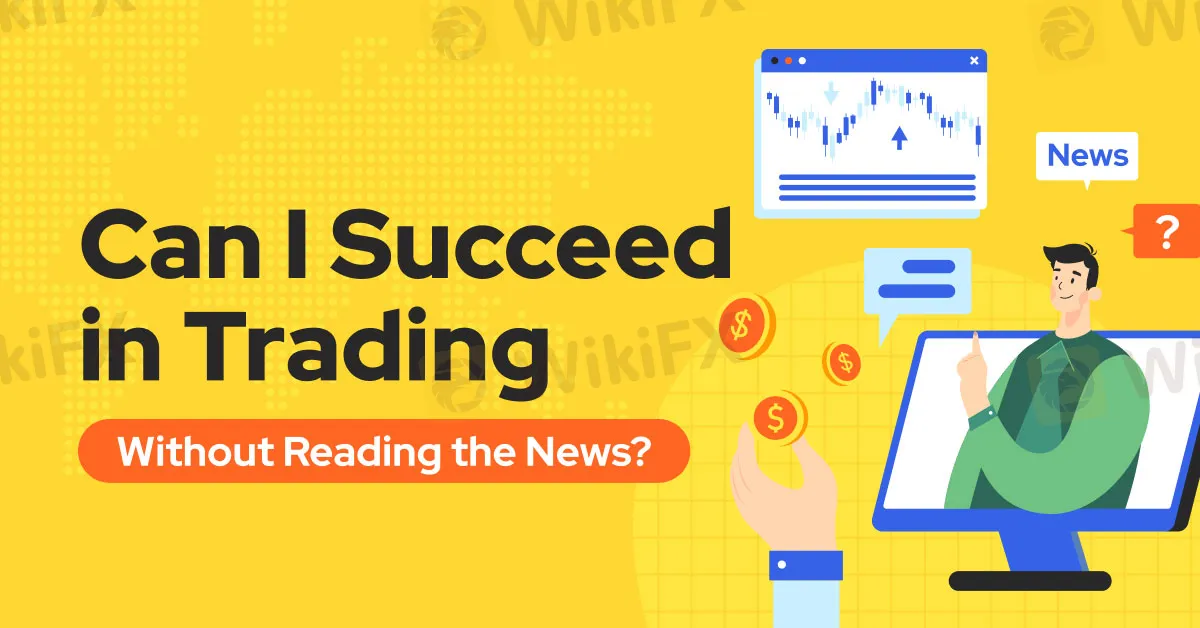
In the fast-paced world of online trading, the notion of bypassing the news entirely might seem appealing. The constant influx of information can be overwhelming, and many traders wonder if they can still succeed without keeping a keen eye on the latest headlines. While it is technically possible to trade without reading the news, the approach requires a strategic shift and an understanding of the inherent risks.

Many traders rely exclusively on technical analysis, which involves studying past market data, primarily price and volume, to predict future price movements. This method hinges on the belief that all relevant information is already reflected in the price, negating the need for external news. Technical indicators like moving averages, RSI, and MACD can guide trading decisions without reference to current events. By focusing solely on these indicators, traders can develop strategies that are purely data-driven, reducing the potential for emotional decision-making influenced by news events.
Another method that eschews traditional news consumption is algorithmic trading. This strategy employs computer programs to execute trades based on pre-set criteria. These algorithms can be designed to react to price changes and patterns, operating independently of any news updates. High-frequency trading firms often use such algorithms to capitalize on market inefficiencies. By leveraging sophisticated algorithms, traders can automate their strategies, ensuring that trades are executed quickly and efficiently, often in milliseconds, without the need for human intervention or news-based adjustments.
Quantitative trading strategies also provide an alternative to news-dependent trading. These strategies involve using mathematical models to identify trading opportunities, analysing historical data to forecast future trends. Quant traders might not need to follow the news if their models are robust and account for various market conditions. By relying on statistical analysis and data-driven insights, quantitative traders can develop strategies that are less susceptible to the volatility induced by breaking news, focusing instead on long-term patterns and probabilities.

While technical analysis and quantitative models can be powerful tools, they might not account for sudden, news-driven market shifts. Major geopolitical events, economic announcements, or unexpected company news can cause significant price swings that purely technical strategies may not anticipate. For example, a sudden geopolitical conflict or an unexpected earnings report can lead to rapid market movements that are difficult to predict using historical data alone. Traders who ignore the news might find themselves unprepared for such events, potentially leading to substantial losses.
Regulatory developments can have profound effects on markets, and staying uninformed could lead to unexpected consequences. New laws or sanctions can disrupt market dynamics, and traders unaware of these changes may find themselves at a disadvantage. For instance, changes in financial regulations or trade policies can impact entire sectors, causing ripple effects across the market. Traders who neglect to stay updated on these developments might miss crucial information that could affect their positions and overall strategy.
News often shapes market sentiment, driving investor behaviour. Positive or negative news can lead to buying or selling frenzies, which are not always predictable through charts and models alone. Ignoring market sentiment can result in missed opportunities or unexpected losses. For example, a positive earnings report can boost a stock's price as investors rush to buy, while negative news can trigger a sell-off. Understanding the mood of the market, which is often influenced by news, can provide traders with valuable context for making informed decisions.

Regardless of a trader's approach to news consumption, effective risk management is paramount. Proper risk management strategies can mitigate the impact of unexpected news events. Techniques such as setting stop-loss orders, diversifying portfolios, and managing leverage ensure that traders can weather adverse market movements. While staying informed can enhance decision-making, disciplined risk management triumphs as the most crucial aspect of successful trading. It acts as a safety net, protecting traders from significant losses that can arise from unpredictable news-driven market changes. By focusing on risk management, traders can maintain a stable and consistent approach, regardless of the latest headlines.

Traders can adopt a balanced approach by being selective about the news they consume. Focusing on key economic indicators, major geopolitical events, and industry-specific news can provide essential context without overwhelming the trader. Tools like news filters and curated feeds can help manage the flow of information. By prioritizing relevant news, traders can stay informed about significant developments while avoiding information overload, allowing them to maintain a clear and focused strategy.
Instead of following the news constantly, traders can set specific times to review important updates. This method allows them to stay informed while maintaining a primary focus on their trading strategies. By dedicating specific times to news review, traders can ensure they are aware of critical information without becoming distracted or reactive. This structured approach can help maintain a balance between staying informed and staying focused on trading goals.
Incorporating fundamental analysis with technical strategies can enhance decision-making. Understanding the broader context of market movements can provide an edge, even for those who primarily rely on technical indicators. By integrating fundamental insights, such as economic data or company performance, with technical analysis, traders can develop a more comprehensive view of the market. This combined approach can help identify opportunities and risks that might be overlooked when relying solely on one method.
While it is possible to trade without reading the news, doing so requires a robust strategy and an acceptance of the associated risks. Traders who choose this path must rely heavily on technical analysis, algorithmic trading, or quantitative models, understanding that they might miss out on significant market drivers. For most, a hybrid approach—integrating selective news consumption with technical analysis—can offer the best of both worlds, providing a comprehensive view of the market landscape and enhancing overall trading success. Effective risk management, however, remains the cornerstone of any successful trading strategy, ensuring protection against unforeseen market movements. By prioritizing risk management and maintaining a balanced approach to news consumption, traders can navigate the complexities of the market with greater confidence and resilience.

Disclaimer:
The views in this article only represent the author's personal views, and do not constitute investment advice on this platform. This platform does not guarantee the accuracy, completeness and timeliness of the information in the article, and will not be liable for any loss caused by the use of or reliance on the information in the article.

Join WikiFX and investors worldwide in celebrating the excitement of the 2026 FIFA World Cup!
Have you experienced issues with Pepperstone deposit & withdrawal processing? From your experience, do you feel that the Australia-based forex broker causes losses to its clients? Did the brokerage entity freeze your account and give you a margin call? All these trading allegations have been rampant on broker review platforms such as WikiFX. This Pepperstone review article takes a close look at the user complaints, especially in 2026. Additionally, we have given an overview of the regulatory framework under which the brokerage entity operates.

Some broker comparisons end with a confident "go with this one." This is not one of them — and that honesty is exactly what makes it worth reading. Wundersys and tradgrip are two young, offshore-registered brokers that keep popping up in front of beginner traders, often through aggressive online marketing. Both promise the usual buffet: tight spreads, generous leverage, multiple account tiers. And both, according to WikiFX, sit near the very bottom of the safety scale. So instead of crowning a champion, this comparison is really about something more useful: learning to read the warning signs, understanding the small differences that still matter, and knowing why "the better of two risky options" is still a conversation about risk.
If you trade forex from India, Pakistan, Bangladesh, Sri Lanka, or Nepal, you already know the quiet truth that eats into every trader's results: it is not just the market that decides whether you profit — it is the cost of getting in and out of each trade. Shave a couple of dollars off your commission on every lot, multiply it across hundreds of trades a year, and you are looking at the difference between a strategy that works and one that bleeds out slowly. South Asian traders are some of the most cost-conscious in the world, and rightly so. So we pulled the data on the brokers most often recommended for the region, cross-checked every name on WikiFX, and ranked them by the one number that matters most here: what they actually charge you to trade. Before the list, one quick lesson that will make this whole ranking click.
 WikiFXWikiFXWikiFXWikiFXWikiFXWikiFXWikiFXWikiFXWikiFXWikiFX
