Abstract: President Yoon Suk Yeol's arrest impacts South Korean markets, currency, and global investments, raising concerns about economic stability and investor confidence.
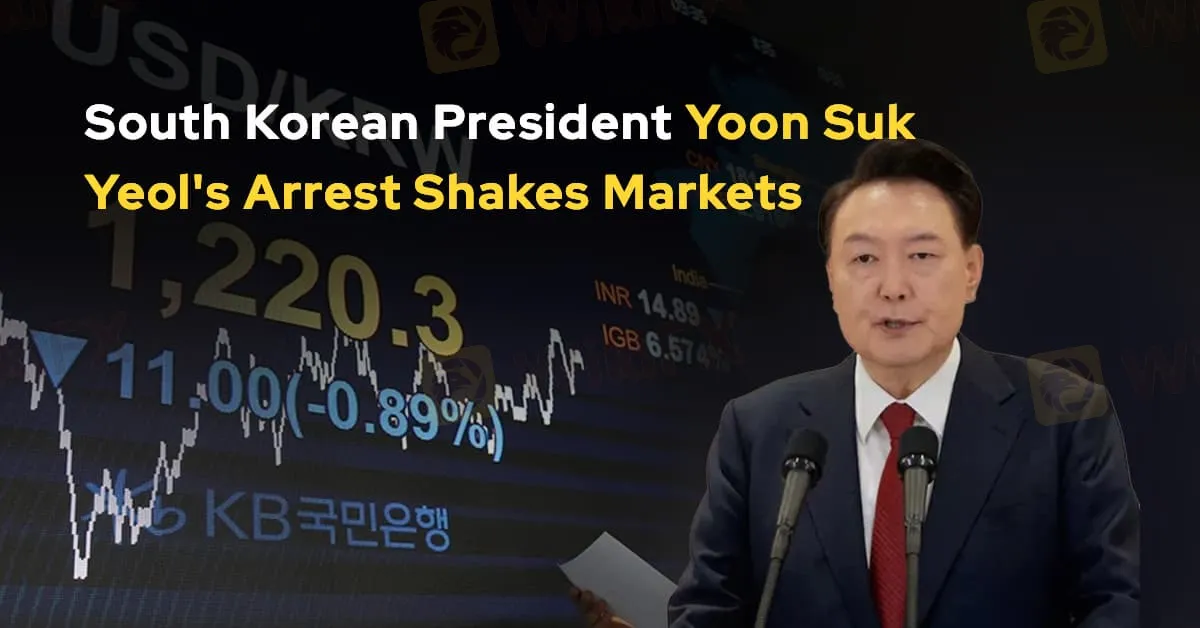
SEOUL, South Korea - The arrest of South Korean President Yoon Suk Yeol on January 15, 2025, has sparked a perfect storm of political and economic instability. Following his impeachment for attempting to implement martial law, the repercussions have had a significant influence on South Korea's financial markets, foreign currency rates, and investor confidence, generating rippling effects across the global economy.

The Impact On Financial Markets
South Korea's prominence as a major global economy necessitates international investors' confidence in its stability. The political instability has caused a flight of foreign money, with $2.58 billion taken from stocks in December 2024, the largest outflow since the COVID-19 market upheaval in 2020. Investors are concerned about the possible disruption to South Korea's main industries, such as its technology and automotive titans, which rely on stable market conditions and policies.
The bond market, which has historically been seen as a secure investment, has not been spared. Foreign investors withdrew $1.28 billion from bonds, the first net withdrawal in nine months. This unusual step underscores significant fears about the nation's long-term economic prospects due to the instability.
Currency Volatility And Its Impact On Trade
The South Korean won has been one of the most heavily impacted indicators, falling 5.2% versus the US dollar in December 2024. This significant devaluation exacerbates inflationary pressures, especially given South Korea's reliance on dollar-denominated imports such as crude oil and raw commodities. While a lower currency may assist exporters in the near term, continuous volatility might strain trade ties and upset long-term commitments.

Foreign exchange reserves are under growing pressure as authorities intervene to maintain the currency, making South Korea exposed to more external shocks.
Gold and Safe-Haven Assets Surge Despite Uncertainty
As South Korea's markets collapse, global investors have rushed to safe-haven assets such as gold, which has traditionally functioned as a buffer during times of upheaval. This move underscores rising concern about the larger consequences of South Korea's political turmoil on the global financial environment. The increasing demand for gold, as well as other safe assets such as US Treasury bonds and the Japanese yen, demonstrates the depth of risk aversion in the face of this instability.
Broader Economic and Social Impacts
The crisis is projected to inflict long-term scars on South Korea's economy.
1. Investment Climate: The $3.86 billion exodus from equities and bonds in December 2024 reflects a major loss of investor faith. Foreign direct investment (FDI) is projected to slow, postponing key infrastructure and industrial projects.
2. Domestic Effects: Rising unemployment, which reached a three-year high of 3.7% in December, indicates declining corporate confidence. Inflation, caused by currency depreciation, has reduced household buying power, reducing consumer expenditure and exacerbating the economic downturn.
3. Policy Uncertainty: President Yoon's impeachment has created a leadership vacuum, creating fears about delays in crucial reforms, budgetary measures, and international trade treaties.
Global and Regional Consequences
South Korea's volatility threatens to destabilize markets well beyond its borders since it is a key player in global supply chains. Major trading partners, such as China, Japan, and the United States, may reconsider their economic relations, as regional markets prepare for more volatility. Because financial institutions are intertwined, the fallout from South Korea's instability may cause worldwide market changes, particularly in the technology and industrial sectors.
Final Thoughts
The arrest of President Yoon Suk Yeol serves as a harsh warning of how political unrest may rapidly turn into economic turmoil. South Korea now has the difficult job of rebuilding investor confidence and guaranteeing policy continuity to protect its economy. The immediate objective is to stabilize its markets and currency while handling the complicated political ramifications.
Globally, this crisis underscores the vulnerability of linked markets in an unpredictable world. As investors and politicians keep a close eye on South Korea, the conclusion will serve as a vital case study in dealing with political and economic crises in an increasingly interdependent globe.