

Global Broker Regulation Inquiry App
WikiFX
English
简体中文
繁體中文
English
Pусский
日本語
ภาษาไทย
Tiếng Việt
Bahasa Indonesia
Español
हिन्दी
Filippiiniläinen
Français
Deutsch
Português
Türkçe
한국어
العربية
Year-End SRF Usage Hits a Record High
Abstract:The Federal Reserves Standing Repo Facility (SRF) saw its usage surge to USD 74.6 billion on the final trading day of 2025, marking an all-time high. At first glance, such a figure may trigger concern
The Federal Reserves Standing Repo Facility (SRF) saw its usage surge to USD 74.6 billion on the final trading day of 2025, marking an all-time high. At first glance, such a figure may trigger concerns about tightening liquidity conditions. However, when viewed in the context of year-end timing, interest rate dynamics, and recent changes to the policy framework, this episode appears less like a stress event and more like a routine, market-initiated pressure test that the Fed successfully absorbed.
First, this development does not point to structural stress within the financial system. Funding conditions typically tighten toward year-end as financial institutions manage regulatory assessments, balance sheet constraints, and year-crossing settlements. In this environment, banks naturally increase their demand for cash. Elevated SRF usage simply reflects a rational liquidity choice: when a readily available facility offers funding at a more attractive price, institutions will use it.
From an interest rate perspective, the surge was not driven by forced borrowing, but by clear arbitrage incentives. As general collateral repo rates climbed to around 3.9%, above the SRF‘s fixed rate of 3.75%, banks predictably shifted toward the Fed. This underscores that the SRF has effectively become a ceiling anchor for short-term rates, validating the Fed’s multi-year effort to redesign its monetary policy operating framework.
More importantly, this episode highlights a structural shift in the Feds role. The central bank is increasingly evolving from a traditional “lender of last resort” into a standing liquidity provider for money markets. In prior cycles, reliance on central bank facilities was often interpreted as a sign of stress. Today, policymakers actively encourage regular and normalized use of the SRF to prevent excessive volatility in market rates. This marks a fundamental change in market psychology, one in which dependence on central bank liquidity support is becoming institutionalized.
That said, risks have not disappeared entirely. Repeated record-high SRF usage, alongside the Feds ongoing short-term Treasury purchases (RMP), also reveals a growing structural reliance by banks on high-quality liquid assets and central bank facilities. Should the Fed materially tighten its balance sheet in the future or reduce its tolerance for liquidity operations, the stability of the front end of the yield curve could once again be tested.
Overall, this “surge” in SRF usage should be viewed as a technical year-end fluctuation, proactively utilized by the market and effectively absorbed by the policy framework, rather than a systemic warning signal. It reinforces a broader message: in a world of high debt and elevated volatility, the Federal Reserve is unlikely to fully exit money markets. Instead, it is increasingly acting as a de facto market maker, a shift with far-reaching implications for rate levels, dollar liquidity, and the pricing of risk assets.
Gold Technical Analysis
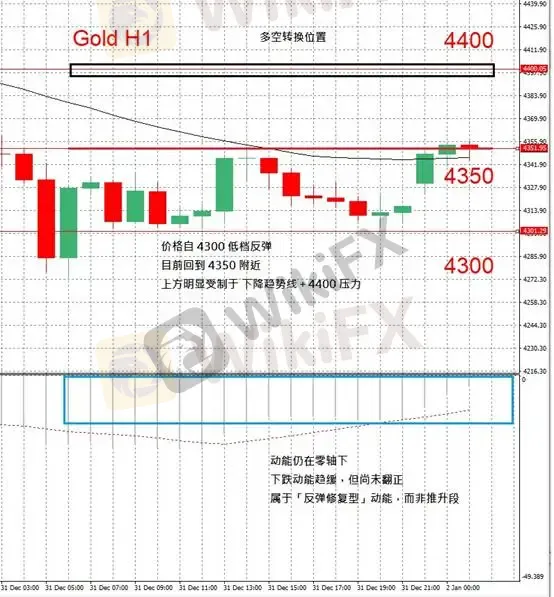
The bullish impact of the Feds rate-cut decision has already been largely priced in during the prior advance. In the short term, gold has failed to extend a one-directional rally and has instead entered a consolidation and structural repair phase, where technical factors dominate price action. On the H1 timeframe, the market is clearly in a post-event digestion phase.
H1 Price Structure
Price rebounded from the 4,300 support zone
Currently trading around 4,350
Upside remains capped by a descending trendline and the 4,400 resistance level
MACD Analysis
Momentum remains below the zero line
Bearish momentum is slowing, but has not yet turned positive
This reflects a corrective rebound, not the start of a new impulsive leg higher
Rate cuts set the direction, but price action determines timing.
At this stage, gold is not initiating a new uptrend. It is digesting bullish expectations and rebuilding its technical structure.
Resistance: 4,400 USD/oz
Support: 4,350 / 4,300 USD/oz
Risk Disclosure
The above views, analyses, research, price levels, and other information are provided solely as general market commentary and do not represent the position of this platform. All readers assume full responsibility for their own risk. Please trade with caution.
Disclaimer:
The views in this article only represent the author's personal views, and do not constitute investment advice on this platform. This platform does not guarantee the accuracy, completeness and timeliness of the information in the article, and will not be liable for any loss caused by the use of or reliance on the information in the article.
WikiFX Broker
Latest News
Retiree’s Tabung Haji Savings Gone: Elderly Retiree Loses RM277,000 After One Whatsapp Message
 WikiFX
Forex Brief: Dollar Dips Ahead of NFP; RBA Bets Lift AUD
WikiFXCrude Oil Rallies to $85 on Escalating Middle East Geopolitical Risks
WikiFXChina Signals Tolerance for Slower Growth with Revised 2026 Outlook
WikiFXOil Surges as Qatar Warns of $150 Crude and 'Force Majeure' Across Gulf Exporters
WikiFXJRJR Review: Safety, Regulation & Forex Trading Details
WikiFXHeroFx Review: Withdrawal Problems, Scam Alert & Risks
WikiFXForex Brief: Yen Weakens Past 157.75 as BoJ Policy Hopes Dim
WikiFXCanadian Regulators Say More Than 7,500 Fraudulent Investment and Crypto Websites Were Taken Down
WikiFXUS NFP Preview: Markets Brace for Volatility as Employment Data Tests Fed's Patience
WikiFXCurrency Calculator
USD

CNY
Current Rate:0
Amount
USD
Available
CNY
Calculate 