

Global Broker Regulation Inquiry App
About WikiFX
English
简体中文
繁體中文
English
Pусский
日本語
ภาษาไทย
Tiếng Việt
Bahasa Indonesia
Español
हिन्दी
Filippiiniläinen
Français
Deutsch
Português
Türkçe
한국어
العربية
اردو


MBI Ponzi Scam Crackdown: Tan Sri Arrested & RM6.65 Billion Asset Seized

WikiFX
|


Abstract:Malaysia’s most explosive financial scandal is reaching its climax, as Tan Sri elites are hauled in, RM6.65 billion in wealth is seized and the once-untouchable MBI empire collapses amid a widening global crackdown.
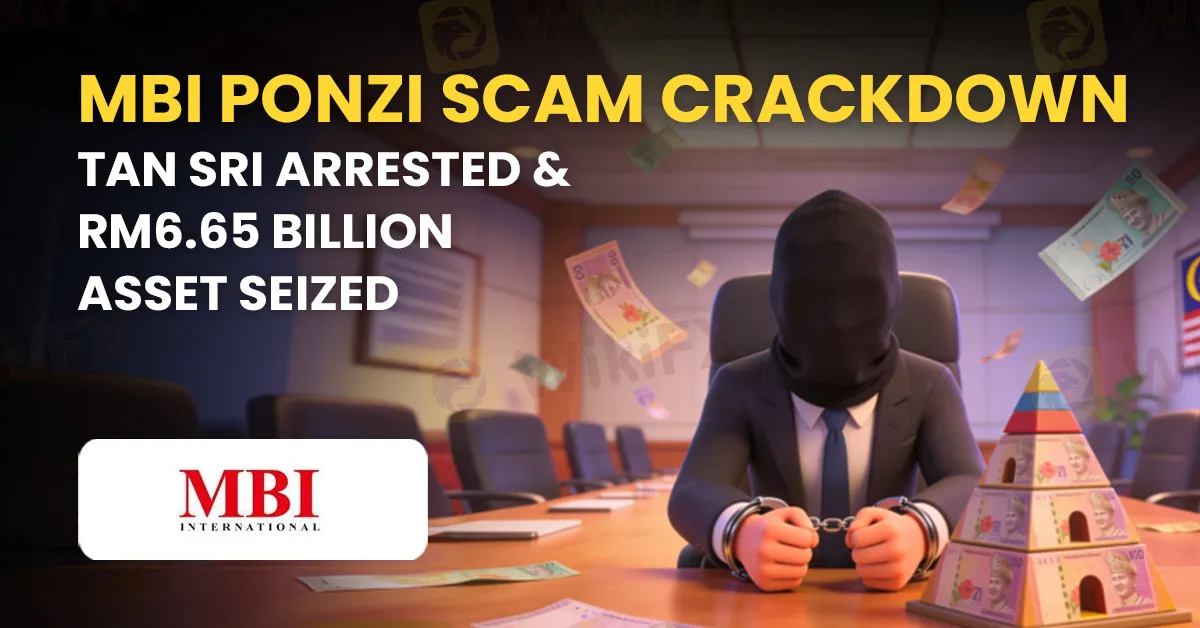
Malaysia‘s authorities have intensified their pursuit of one of Southeast Asia’s most notorious financial frauds, as new details emerge about the scale of enforcement action taken against the now-defunct MBI Group. The government has confirmed that 23 individuals, including prominent figures holding high-ranking honorific titles, have been arrested, while assets worth RM6.65 billion have been seized as part of an ongoing crackdown on the Ponzi scheme.
The arrests stem from a series of coordinated enforcement actions carried out last year under an operation known as “Op Northern Star”. The operation was led by Bukit Amans anti-money laundering division and targeted the financial networks that sustained MBI after its collapse. Authorities have described the effort as one of the largest anti-fraud operations ever undertaken in the country.
As part of the legal process, prosecutors filed a notice at the Butterworth High Court in late December 2025 seeking the forfeiture of 642 properties and bank accounts linked to the children of MBI founder Tedy Teow Wooi Huat. The application was made under Section 56(1) of the Anti-Money Laundering, Anti-Terrorism Financing and Proceeds of Unlawful Activities Act 2001. The assets involved are estimated to be worth more than RM1.25 billion, highlighting the vast sums channelled through family-linked entities.
The issue was raised in Parliament during a Special Chamber session, where lawmakers pressed the government on enforcement failures and recovery efforts related to the MBI scandal. In response, the Finance Ministry outlined the scale of progress made and reaffirmed its commitment to ensuring that illicit gains are recovered and dealt with in accordance with the law.
MBI, founded in Penang, operated between 2012 and 2018 and grew into a cross-border fraud of exceptional scale. Investigators believe the scheme lured between two million and 11 million victims worldwide, with most losses reported in China, Malaysia and Thailand. The scheme relied on aggressive recruitment, promises of high returns and complex payment structures typical of large Ponzi operations.
Teow, the central figure behind MBI, is currently in custody in China after being extradited from Thailand in August 2024. Chinese authorities have charged him with defrauding roughly two million citizens, making the case one of the countrys largest overseas-linked financial crimes.
Malaysia is now working closely with Chinese law enforcement agencies through formal mutual legal assistance. Investigators and deputy public prosecutors travelled to Chongqing in January 2026 to advance evidence-gathering efforts and obtain foreign conviction records to strengthen domestic prosecutions.
Beyond seizures and arrests, police have also issued compound fines totalling RM339.5 million to proxies involved in the scheme, with RM131.5 million already recovered. Officials say this approach is aimed at accelerating asset recovery while holding accomplices financially accountable.
At the policy level, the government is reinforcing defences against investment fraud. Rapid-response mechanisms, public alert lists maintained by financial regulators and a new National Financial Literacy Strategy for 2026–2030 are being positioned as key tools to reduce exposure to scams in an increasingly digital economy. Together, these measures reflect a broader attempt to ensure that the scale of the MBI scandal is not repeated.

Disclaimer:
The views in this article only represent the author's personal views, and do not constitute investment advice on this platform. This platform does not guarantee the accuracy, completeness and timeliness of the information in the article, and will not be liable for any loss caused by the use of or reliance on the information in the article.
WikiFX Broker
Latest News
Still Trusting Telegram Signals? This Is Why You Are Still Not a Profitable Trader
WikiFXDarwinex Review: Regulated but Office Not Found with Trader Complaints?
WikiFXBROKSTOCK Review: What Traders Should Know Before Depositing
WikiFXRBI Ends Deposit Rate Discrimination Between Branches
WikiFXOROKU EDGE Review: Blacklisted by SCM Malaysia and Users Report Frozen Funds
WikiFXWhy Do Forex Brokers Show Different USD/MYR Quotes?
WikiFXAs Warsh‘s Fed faces pressure to act on inflation, these indicators show it’s at its lowest in years
WikiFXRomance Scam Targets Hong Kong Actress for RM156,000
WikiFXFONDEX Review 2026: Things FONDEX Broker Might Not Want You To See
WikiFXVAULT MARKETS Review: Is Your Deposit Safe?
WikiFX