Abstract:You are probably here because you searched for an "Evest Review," trying to answer one important question: "Is Evest a safe and trustworthy broker for my capital?" The answer is complicated and very worrying. On the outside, Evest looks legitimate because it is regulated by the Financial Sector Conduct Authority (FSCA) in South Africa. However, it also has a much weaker offshore license from the VFSC.
More importantly, this regulatory status doesn't match up with many serious user complaints. These are not small problems; they are serious accusations about major withdrawal problems, very aggressive account management, and claims of complete fraud. This review is a thorough investigation designed to look past the marketing and study the facts. Our goal is to give you the important information needed to make an informed and, most importantly, safe decision about your investments.
Answering Your Main Question
You are probably here because you searched for an “Evest Review,” trying to answer one important question: “Is Evest a safe and trustworthy broker for my capital?” The answer is complicated and very worrying. On the outside, Evest looks legitimate because it is regulated by the Financial Sector Conduct Authority (FSCA) in South Africa. However, it also has a much weaker offshore license from the VFSC.
More importantly, this regulatory status doesn't match up with many serious user complaints. These are not small problems; they are serious accusations about major withdrawal problems, very aggressive account management, and claims of complete fraud. This review is a thorough investigation designed to look past the marketing and study the facts. Our goal is to give you the important information needed to make an informed and, most importantly, safe decision about your investments.
Evest at a Quick Look
A fast look at the broker's services shows a worrying imbalance. The few good points are heavily overshadowed by major operational and ethical warning signs reported by users.
Understanding Evest's Regulation
A broker's regulatory status is the foundation of its trustworthiness. A license is not just a badge; it's a measure of the protection you have as a trader. Evest operates under a two-license structure, which needs careful examination. One license provides some oversight, while the other introduces significant risk.
The FSCA License: Basic Oversight
Evest holds a license (No. 36060) from the Financial Sector Conduct Authority (FSCA) of South Africa. The FSCA is a legitimate regulatory body that sets certain standards for financial service providers. This includes requirements for operational transparency and the handling of client funds. For any broker, having a license from a respected, onshore regulator, such as the FSCA, adds credibility. It suggests that the broker is, at some level, willing to submit to oversight. However, for international clients, the protection offered by this specific license may be limited, which is why the second license is so important to understand.
The VFSC License: Offshore Warning Sign
The other license held by Evest (No. 17910) is from the Vanuatu Financial Services Commission (VFSC). Vanuatu is a well-known offshore location. “Offshore regulation” is a term that should immediately signal caution to any trader. Regulators, such as the VFSC, are known for having much lower capital requirements, less strict reporting standards, and weaker enforcement mechanisms compared to top-tier regulators in places such as the UK, Australia, or the European Union. For brokers, getting an offshore license is often faster, cheaper, and allows it to operate with fewer restrictions.
Why This Matters for Your Capital
This two-license structure is a common tactic. A broker can use the more reputable onshore license (FSCA) in its marketing to build trust, while potentially signing up clients through the offshore entity (VFSC). When your account is held under an offshore entity, you may lose access to important protections, such as separated fund accounts or compensation schemes, which might be available under a stronger regulatory framework. This structure exposes traders to high potential risk, as getting help in the event of a dispute or bankruptcy can be extremely difficult, if not impossible.
A broker's regulatory status is the single most important factor for your safety. We strongly advise traders to verify these licenses and read the latest regulatory updates on a trusted platform, such as WikiFX, before depositing.
Breaking Down User Complaints
While regulatory status tells part of the story, the real-world experiences of a broker's clients tell the rest. A single negative review can be an outlier, but when a consistent pattern of serious accusations emerges across multiple platforms, it points to system-wide issues. The user complaints filed against Evest on platforms, such as WikiFX, are numerous, consistent, and alarming. Let's examine the recurring themes.
Pattern 1: Aggressive Account Managers
A primary and deeply disturbing pattern involves the behavior of account managers. Legitimate brokers provide support, not high-pressure sales. Yet, user after user reports being pressured by Evest account managers to deposit more and more funds. The tactics described go far beyond professional encouragement.
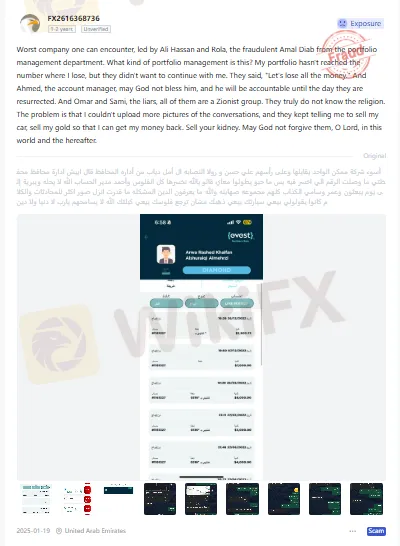
Users claim managers constantly call, pushing them to increase their investment with promises of guaranteed returns or exclusive opportunities. The pressure is not just to deposit savings; it escalates to shocking extremes. One user documented being told by their manager to “sell my car, sell my gold... Sell your kidney” to fund the account after facing losses. This is not financial advice; it is predatory behavior designed to extract as much capital as possible from a client, regardless of the consequences.
Pattern 2: Problems Withdrawing Funds
The second major warning sign is the widespread difficulty, and often impossibility, of withdrawing funds. Numerous complaints detail a frustrating and often fruitless process. When a user requests a withdrawal, their account manager allegedly becomes evasive or outright hostile.
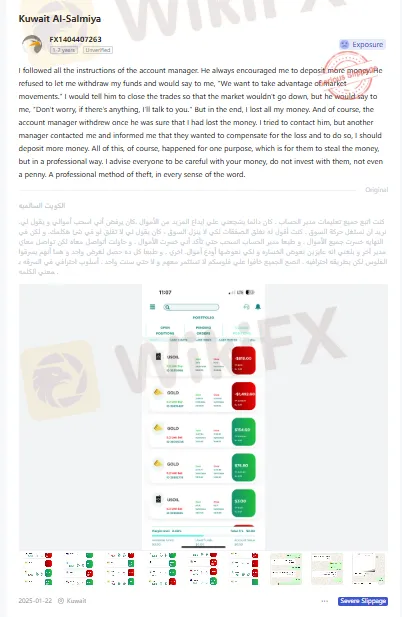
A common tactic reported is the manager refusing the withdrawal request under the excuse of an urgent trading opportunity. Users are told things like, “We want to take advantage of market movements,” effectively holding their money hostage to force them into more trades. When clients insist on withdrawing, they report that managers stop responding, phone lines go dead, and the funds remain locked in the account until they are eventually lost in subsequent trades.
Pattern 3: Claims of Deliberate Loss
The most severe complaints claim a “professional method of theft.” The pattern described is nightmarish: a client deposits funds and follows the explicit instructions of their account manager. The manager encourages them to take on increasingly risky positions. Then, in a final, devastating series of trades, the entire account balance is wiped out.
Immediately following this total loss, the once-attentive account manager becomes unreachable. When the client tries to contact Evest, they are either ignored or, in some reported cases, are contacted by a *new* manager. This new manager acknowledges the loss but claims it can be recovered if the client simply deposits more money. This cycle of deposit, manager-led loss, and pressure for a new deposit is a hallmark of fraudulent operations.
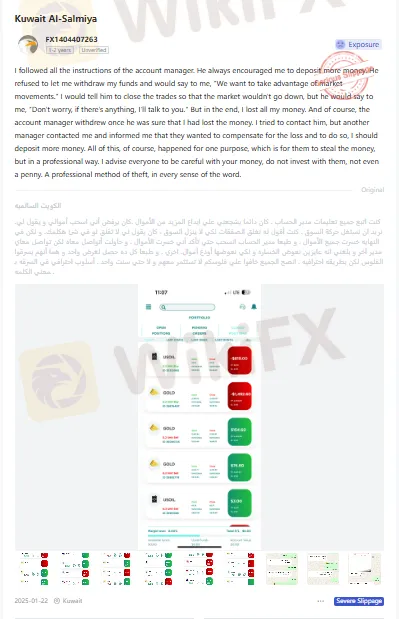
These firsthand accounts paint a disturbing picture. To protect yourself, you can review the full, unedited complaints and check for any new reports filed against Evest by visiting its detailed profile on the WikiFX inquiry platform.
Evest's Trading Conditions
Beyond the serious user complaints, an objective analysis of Evest's trading conditions reveals an environment that is expensive and uncompetitive for the average trader.
Account Levels and Spreads
Evest structures its offerings across four account levels, with trading conditions improving significantly as the deposit amount increases. This creates a high barrier to entry for fair pricing.
The Silver account, with a $250 minimum deposit, has a starting spread of 1.8 pips. This is not competitive by modern industry standards, where spreads of 1.0-1.2 pips are common for entry-level accounts. To access reasonably tight spreads (e.g., 0.9 pips), a trader must deposit a substantial $20,000 for a Platinum account. The best spreads are reserved for the Diamond account, requiring a prohibitive $50,000 deposit. This structure heavily penalizes smaller retail traders.
The Non-Trading Fees
A broker's true cost is often hidden in its non-trading fees. Evest imposes several fees that can quickly reduce a trader's capital, especially if the account is not actively traded or if frequent withdrawals are made.
· Inactivity Fee: Evest charges a steep $75 fee after just two months of inactivity. This is a particularly aggressive policy, as many reputable brokers have longer grace periods (6-12 months) and lower fees. This fee can drain a small, dormant account in a matter of months.
· Withdrawal Fee: A fee of $5 is charged for every withdrawal. While not excessive on its own, it discourages traders from making small, regular withdrawals. The minimum withdrawal amount is $25.
· Conversion Fee: A significant 2% conversion fee may be applied. This is a high charge for converting funds between currencies and can be a major hidden cost for international clients whose account currency differs from their deposit currency.
· Withdrawal Time: Evest states that withdrawal processing can take up to seven business days. This is considerably slower than the industry average, where many brokers process withdrawals within 1-3 business days. Lengthy withdrawal times are a recurring point of frustration in user complaints.
Platform and Tools
The trading platform is a trader's most important tool. It is the gateway to the markets and must be reliable, fast, and feature-rich. In this area, Evest makes a decision that places it at a significant disadvantage.
Evest does not offer MetaTrader 4 (MT4) or MetaTrader 5 (MT5). This is a major drawback. MT4 and MT5 are the undisputed industry-standard platforms, used by millions of traders and supported by thousands of brokers worldwide. Their popularity stems from their powerful charting tools, robust and stable infrastructure, and, most importantly, their vast ecosystem of third-party tools.
By limiting users to its proprietary “Evest Global Markets App,” the broker creates several problems for traders:
· No Expert Advisors (EAs): Traders who rely on automated trading strategies or EAs cannot use them with Evest. They lose the ability to deploy systems they may have spent years developing or purchasing.
· Limited Custom Indicators: The community around MT4/MT5 has created tens of thousands of custom indicators. Traders on Evest are confined only to the tools built into the proprietary app.
· Vendor Lock-In: Using a proprietary platform locks you into the broker's ecosystem. If you decide to switch brokers, you cannot take your platform setup with you. You must learn a new interface from scratch.
· Reliability Concerns: Industry-standard platforms, such as MT5, have been battle-tested over decades. Proprietary platforms may lack the same level of stability, feature depth and security, making them a less reliable choice for serious trading.
Final Verdict: High Risk Overriding Potential
After a thorough analysis of its regulatory standing, user feedback, trading costs and platform technology, our conclusion on Evest is clear.
The broker operates with a surface of legitimacy thanks to its FSCA license in South Africa. However, this is fundamentally undermined by its high-risk offshore license in Vanuatu. This two-license structure, combined with a non-competitive and expensive fee schedule and the lack of industry-standard platforms, already makes it a questionable choice.
But the most critical factor—the one that overrides all others—is the overwhelming volume of consistent, severe user complaints. The accusations of aggressive sales tactics, an inability to withdraw funds, and methodical, manager-led destruction of client capital are not isolated incidents. They form a pattern of behavior that points to a deeply problematic, if not predatory, business model. The risks documented by former clients are simply too great to ignore.
Given the significant and consistent warning signs raised by user experiences and the risks associated with its offshore regulatory status, we cannot recommend Evest as a safe or trustworthy broker for any trader.
Choosing a broker is a critical decision. This Evest review highlights the necessity of thorough research. Before you ever deposit funds with *any* broker, make it a standard practice to conduct a full background check on a comprehensive regulatory inquiry platform like WikiFX. It is an essential step to protect your capital.
Want the latest forex trading insights, news and scam reports? Download the new WikiFX app where everything is forex. Scan this QR code to get started.