

Global Broker Regulation Inquiry App
About WikiFX
English
简体中文
繁體中文
English
Pусский
日本語
ภาษาไทย
Tiếng Việt
Bahasa Indonesia
Español
हिन्दी
Filippiiniläinen
Français
Deutsch
Português
Türkçe
한국어
العربية
اردو


LMFX Review: Should You Trade with This Broker?

WikiFX
|


Abstract:In this LMFX review, we examine the broker’s background, services, and most importantly its regulatory standing.
In this LMFX review, we examine the brokers background, services, and most importantly its regulatory standing. For traders in Malaysia, choosing an online broker should never depend only on leverage, promotions, or the promise of fast execution. Regulation remains one of the most important factors when deciding where to place funds.
According to publicly available information on WikiFX, LMFX has a WikiScore of 2.23 out of 10. This is a relatively low score and may indicate issues that prospective clients should assess carefully before opening an account.
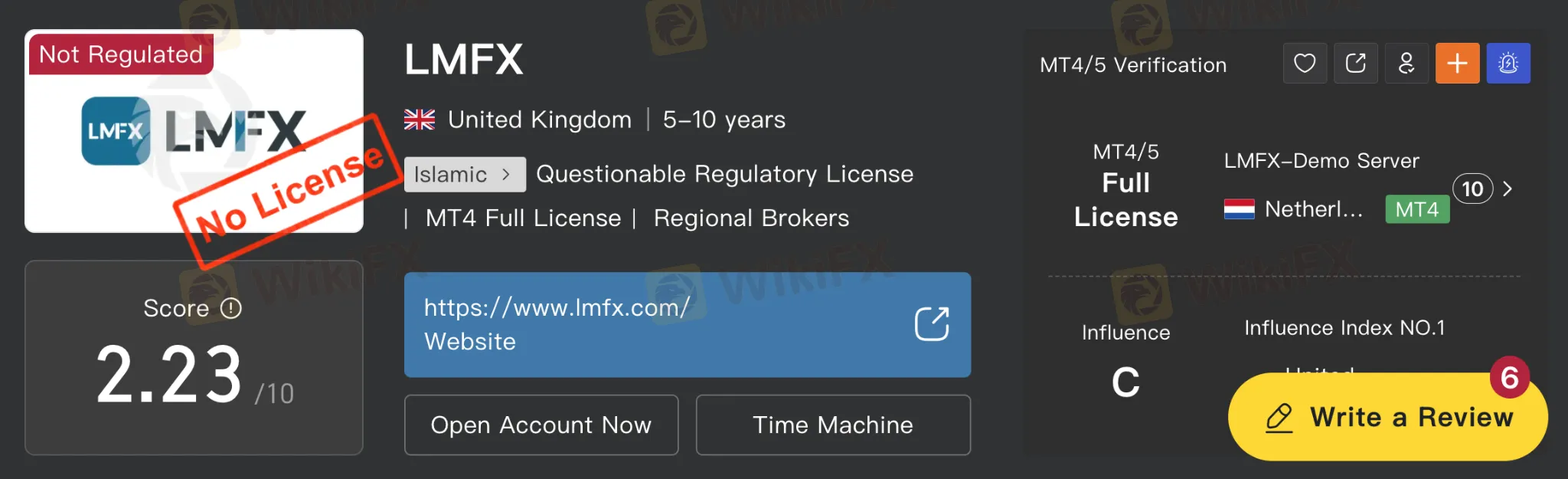
View WikiFXs full review on LMFX here: https://www.wikifx.com/en/dealer/6591273978.html
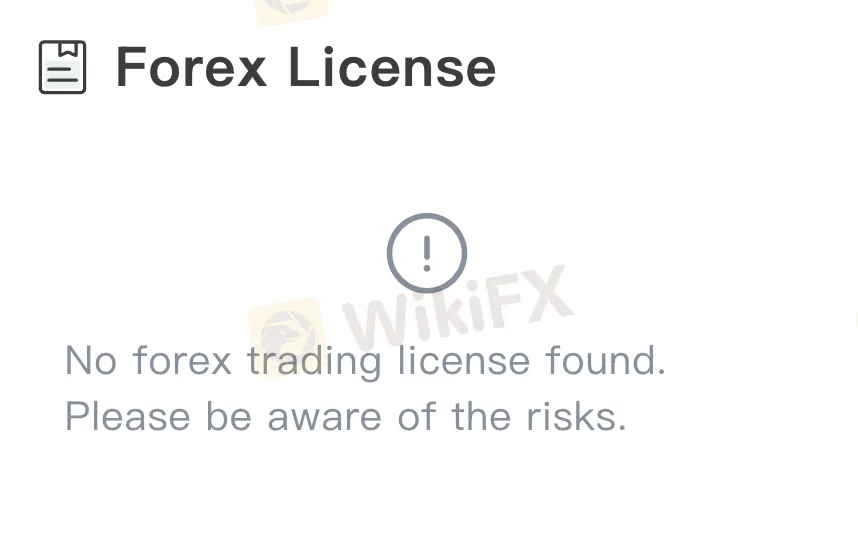
A major concern highlighted in any review LMFX is that the broker does not currently hold a recognised regulatory licence. This raises important questions regarding investor protection, operational transparency, and accountability.
 Contents
LMFX Regulation Status
Any serious discussion of regulation LMFX must begin with its licensing position. Based on available information, LMFX does not have a valid regulatory licence in place.
This means the broker is not operating under the supervision of recognised financial authorities such as the Financial Conduct Authority in the United Kingdom, the Australian Securities and Investments Commission, the Cyprus Securities and Exchange Commission, the Monetary Authority of Singapore, or the Securities Commission Malaysia.
These regulators are generally responsible for ensuring that licensed financial firms meet standards designed to protect clients and preserve confidence in the market. Requirements often include maintaining adequate capital, segregating client funds from company operating money, handling complaints fairly, and providing transparent risk disclosures.
Without such oversight, traders may face fewer safeguards if disputes arise. For Malaysian investors researching LMFX regulation, the absence of recognised licensing should be considered a significant warning sign.
Complaint Regarding Withdrawal Issues
Another factor worth noting in this LMFX review is that WikiFX has received a complaint concerning withdrawal issues from an LMFX trading account.
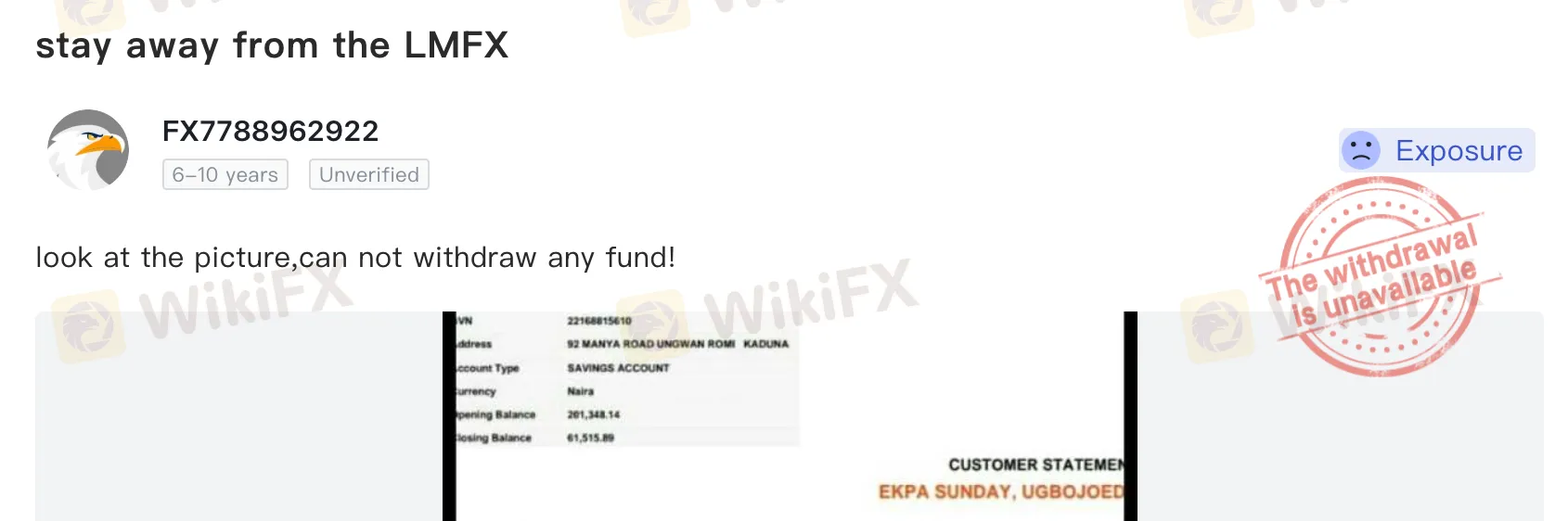
This type of complaint should not be taken lightly. In the online forex industry, withdrawal problems are widely regarded as one of the most serious warning signs because traders may only discover operational issues after they attempt to access their own funds.
A broker may appear satisfactory during the deposit and trading stage, but the real test often comes when a client requests a withdrawal. Delays, repeated verification demands, partial payments, or unexplained refusals can create significant financial stress for customers.
More broadly, withdrawal disputes remain one of the biggest problems in the forex trading industry. For this reason, any complaint related to fund withdrawals deserves careful attention, particularly when the broker is not regulated by a recognised authority.
Complaint Regarding High Spreads
There has also been a complaint alleging that spreads with LMFX were higher than expected. Spread related complaints are important because spreads directly affect trading costs and can significantly reduce profitability, especially for short term traders and frequent market participants.
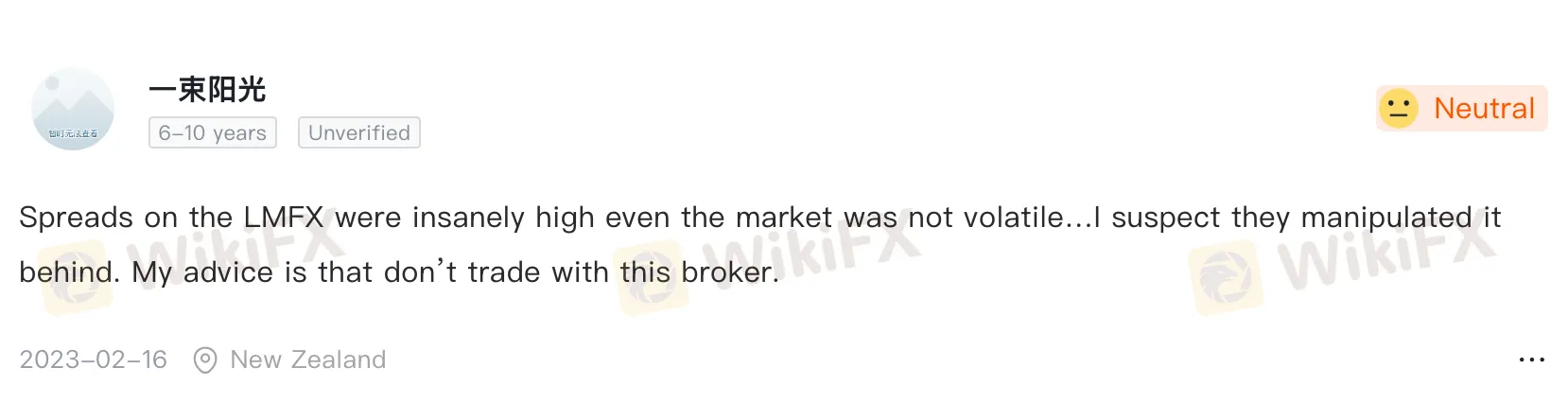
When spreads are wider than anticipated, traders may need the market to move further in their favour simply to break even. For this reason, competitive and transparent pricing is an important factor when evaluating any broker.
Why Choosing an Unregulated Broker Can Be Costly
Selecting a broker with no regulatory licence can become an expensive mistake, particularly for retail traders dealing with overseas entities.
One of the most common concerns involves withdrawals. If clients experience delays or rejected requests, there may be no independent regulator available to investigate or intervene. This can leave customers with limited practical remedies.
Transparency is another issue. Regulated brokers are often required to disclose company ownership, trading costs, key risks, and complaint procedures. Unregulated brokers may provide less clarity or fewer enforceable commitments.
There is also the matter of client fund handling. Many regulators require licensed firms to separate client money from business operating funds. Without regulation, traders may have less certainty about how deposits are managed.
Cross border recovery can also be difficult for Malaysian traders. Taking legal action against an overseas unregulated broker may be expensive, time consuming, and uncertain.
By contrast, brokers with recognised licences usually provide stronger accountability, clearer compliance standards, structured complaint channels, and a higher level of trust.
Final Verdict on LMFX
This LMFX review shows a broker offering access to multiple leveraged markets, various account options, and established trading platforms. However, the central issue remains regulation.
The subject of LMFX regulation cannot be overlooked. Based on available information, the broker does not hold a recognised financial regulatory licence, while carrying a low WikiScore of 2.23 out of 10.
The existence of a withdrawal related complaint adds another layer of concern, as access to funds is one of the most critical issues in broker selection.
In conclusion, LMFX, also referred to as broker LMFX, should be regarded as a high risk broker due to its unregulated status. Malaysian traders are advised to proceed with caution and strongly consider licensed alternatives before depositing funds.
Disclaimer:
The views in this article only represent the author's personal views, and do not constitute investment advice on this platform. This platform does not guarantee the accuracy, completeness and timeliness of the information in the article, and will not be liable for any loss caused by the use of or reliance on the information in the article.
WikiFX Broker
Latest News
Managing False Breakouts: How to Spot and Trade the Liquidity Sweep Trap
WikiFXRoboForex Review 2026: Regulatory Warnings and Withdrawal Red Flags
WikiFXLONG ASIA Review 2026: Unverified Regulation and Withdrawal Risks
WikiFXYen Drops Past 163 On Oil
WikiFXUS Charges Two Over Alleged $43M Laundering Network
WikiFXSix Arrested in ₹2.68Cr Dubai-Linked Scam on Ex-IAF Officer
WikiFXHow to Tell if a Market Reversal at Support is Real
WikiFXBeirman Capital Review 2026: Unregulated Status and Key Risk Signals
WikiFXWhy the rupee keeps sliding despite RBI's $675bn arsenal
WikiFXSix Arrested in ₹20 Million Dubai-Linked Investment Scam
WikiFX