Abstract:When choosing a forex broker, nothing matters more for a trader's safety than regulation. It creates the foundation of trust, making sure your capital is secure and trading is fair. This leads us to Duhani Capital, a broker that has raised serious questions about its DUHANI Regulation status. For any trader thinking about using this platform, understanding its regulatory position isn't just paperwork—it's a vital step in managing risk. Our research, based on a complete review of public information and user reports, shows major warning signs. We found a troubling lack of reliable financial oversight that puts potential clients at serious risk. This article will break down the broker's company structure, examine its license claims, and look at real user experiences to give a clear, fact-based picture of the risks involved.
DUHANI's Critical Regulation Question
When choosing a forex broker, nothing matters more for a trader's safety than regulation. It creates the foundation of trust, making sure your capital is secure and trading is fair. This leads us to Duhani Capital, a broker that has raised serious questions about its DUHANI Regulation status. For any trader thinking about using this platform, understanding its regulatory position isn't just paperwork—it's a vital step in managing risk. Our research, based on a complete review of public information and user reports, shows major warning signs. We found a troubling lack of reliable financial oversight that puts potential clients at serious risk. This article will break down the broker's company structure, examine its license claims, and look at real user experiences to give a clear, fact-based picture of the risks involved.
An Unregulated, High-Risk Profile
Our main finding is clear and straightforward: Duhani Capital operates in a high-risk, unregulated environment. This conclusion isn't based on opinions but on factual analysis of the broker's verifiable credentials, or lack of them. For a trader, this status immediately raises the risk of losing capital to the highest level. Let's look at the evidence that leads to this critical assessment.
No Verified Forex License
The most definitive piece of evidence is the complete absence of a valid forex trading license from any reputable regulatory body. Our check confirms the “No forex trading license found” status. Reputable brokers are authorized and supervised by top-tier regulators such as the FCA in the UK, the CySEC in Cyprus, or the ASIC in Australia. These bodies enforce strict rules on client fund separation, operational transparency, and capital requirements. Duhani Capital does not hold any such license. This means it operates without the mandatory oversight that protects traders from bad practices, bankruptcy, or fraud.
Understanding the “High Risk” Warning
Independent verification platforms give scores to brokers based on a comprehensive set of criteria, including licensing, business practices, and risk management. Duhani Capital receives an extremely low score of 1.99 out of 10. This score comes with an explicit warning: “Warning: Low score, please stay away!” Such a low rating and direct warning are not given lightly. They are reserved for entities that show multiple characteristics of a high-risk operation, signaling a significant potential threat to investor capital. This score is a numerical reflection of the broker's lack of regulatory legitimacy and the potential dangers it poses to clients.
Consequences of Non-Regulation
Trading with an unregulated broker, such as Duhani Capital, has severe and practical consequences. The protections that traders in regulated markets take for granted are entirely absent. These consequences include:
· No Client Fund Protection: Regulated brokers are required to keep client funds in separate accounts, apart from the company's operational capital. Without regulation, your funds can be mixed with company funds, meaning it could be used for business expenses or be inaccessible if the company faces financial trouble.
· No Dispute Resolution: If Duhani Capital refuses a withdrawal request, manipulates trades, or engages in other unfair practices, you have no official body to appeal to. There is no ombudsman or regulatory authority to mediate the dispute or enforce a resolution.
· Lack of Operational Oversight: No one is monitoring the broker's day-to-day operations. This includes verifying the fairness of their price feeds, the execution of trades, and their internal risk controls. This lack of supervision creates an environment where bad practices can occur without consequence.
To verify these critical details and see the full risk assessment in real-time, we strongly advise traders to review the broker's profile on a verification platform. You can see the complete WikiFX report and warnings for DUHANI here.
Breaking Down License Claims
High-risk brokers often use misleading language and irrelevant registrations to create a false appearance of legitimacy. It is a common tactic designed to confuse traders who may not understand the details of financial regulation. A deep dive into Duhani Capital's corporate details and claimed licenses reveals a classic example of this strategy. We will break down each claim to show why it does not provide the safety and oversight required for forex trading.
Registration vs Regulation
Duhani Capital states that Duhani Capital Ltd is established in Dominica. This is a critical distinction that many traders miss. Registering a company in an offshore jurisdiction, such as Dominica, is a simple, low-cost administrative process. It is a business registration, not a financial license. It provides the company with a legal identity but offers zero financial oversight, no conduct rules, and no protection for clients. It is fundamentally different from being regulated by a financial authority that actively supervises a broker's activities.
Analyzing Suspicious Claims
The broker makes two other claims that appear official but are insufficient for ensuring trader safety.
First, Duhani Capital claims to be a registered MSB (Money Service Business) with the US FinCEN (Financial Crimes Enforcement Network). While this sounds impressive, a FinCEN registration is solely for anti-money laundering (AML) tracking purposes. It is not an authorization to operate as a forex or CFD broker. In the United States, a forex broker must be regulated by the Commodity Futures Trading Commission (CFTC) and be a member of the National Futures Association (NFA). Duhani Capital holds neither of these. Citing a FinCEN registration is a common misdirection tactic.
Second, the company states it is “partnered with Financial Master Management Ltd,” which supposedly holds a “Master Financial Dealer License.” This claim is problematic for two reasons. The license is not held directly by Duhani Capital, but by a third-party partner, which reduces any accountability. Furthermore, the legitimacy, jurisdiction, and authority of this “Master Financial Dealer License” are questionable and do not provide the strong protections offered by a top-tier regulator.
The MT5 Software License
Duhani Capital advertises that it has a “Full License MT5.” This simply means the broker has paid the software developer, MetaQuotes, for a license to use the MetaTrader 5 trading platform. This is a technology purchase, equivalent to a business buying a license for Microsoft Office. It has absolutely no connection to financial regulation. The MT5 license does not imply that MetaQuotes or any other body is supervising the broker's financial conduct, solvency, or treatment of clients. It is a software license, not a mark of trustworthiness.
To clarify the gap between Duhani's claims and the reality of trader protection, we have compiled the following table:
A Pattern of User Complaints
The theoretical risks associated with an unregulated broker become real when we examine real-world user experiences. The “Exposure” section on verification platforms serves as a public record of trader complaints, and for Duhani Capital, it paints a troubling picture. These are not isolated incidents but a pattern of serious allegations that align perfectly with the dangers of operating outside a regulated framework.
Withdrawal and Rebate Issues
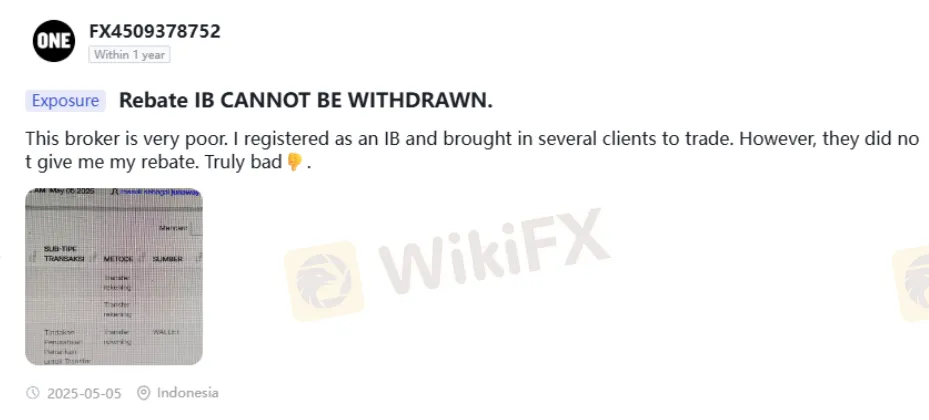
A primary function of any legitimate broker is to process withdrawals reliably. However, multiple users report significant problems in this area. One Introducing Broker (IB) from Indonesia stated they brought clients to the platform but were denied their earned rebates, stating, “This broker is very poor... they did not give me my rebate. Truly bad.”
Another trader from Indonesia reported a more severe issue: “Unable to withdraw Profit on the grounds of cheating, even though trading is normal and the account is banned.”
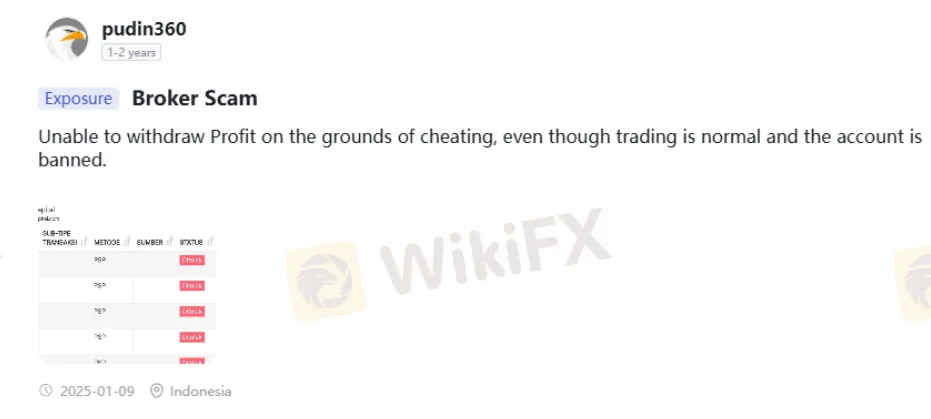
This practice of blocking profitable accounts and taking funds under vague accusations is a hallmark of predatory brokers.
Allegations of Bad Practices
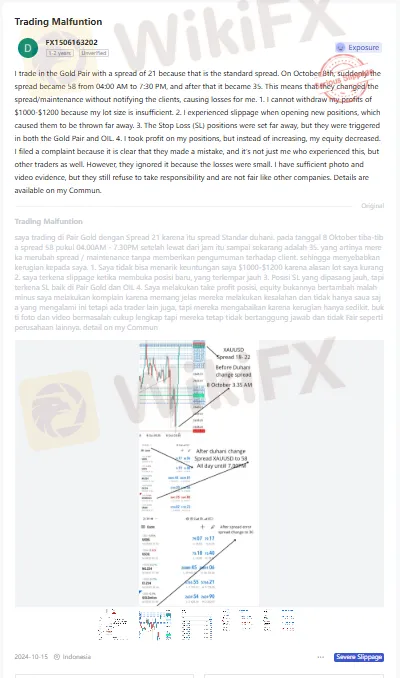
Beyond withdrawal problems, users have detailed specific instances of trading malpractice. An Indonesian trader provided a comprehensive account of unfair conditions experienced on October 8th, 2024. Their complaints included:
· Sudden Spread Changes: The spread on the Gold pair, normally around 21, allegedly jumped to 58 for several hours without any notification, leading to unexpected losses.
· Slippage and Stop Loss Issues: The trader reported severe slippage on new positions and that stop-loss orders were triggered unfairly, even when the market price did not appear to reach the specified level.
· Profit Calculation Errors: In a particularly alarming claim, the trader noted that their account equity decreased after closing profitable positions, indicating a potential manipulation of the platform's accounting.
Despite providing photo and video evidence, the trader claims the broker ignored their complaint and refused to take responsibility.
A Look at Positive Reviews
In sharp contrast to these detailed negative accounts, an analysis of Duhani Capital's positive reviews reveals a suspicious pattern. A large cluster of highly generic positive reviews were posted in a very narrow timeframe, between March 20 and March 25, 2025. These reviews predominantly come from a few specific countries, notably Nigeria and India, and often use similar, vague phrasing like “intuitive and user friendly” or “smooth and reliable.” This concentrated flood of generic praise can be a red flag for fake or incentivized review campaigns, which are sometimes used to artificially inflate a broker's reputation and drown out negative feedback.
These firsthand accounts are invaluable for due diligence. To read the full details of these complaints and check for any new reports, traders can access the user review section on DUHANI's WikiFX profile here.
Verdict and How to Protect Yourself
After a thorough analysis of the evidence, our conclusion is clear and firm. The lack of credible DUHANI Regulation is not a minor detail but the central fact that defines this broker. This, combined with misleading license claims and a documented pattern of severe user complaints, makes Duhani Capital a high-risk entity that traders should approach with extreme caution.
Our Final Assessment
Duhani Capital operates without the oversight of any reputable financial regulator. Its claims of legitimacy are based on irrelevant business registrations and software licenses that offer no protection to clients. The documented user experiences—ranging from withdrawal denials to alleged trade manipulation—are the practical outcome of this unregulated environment. Based on this overwhelming evidence, we cannot recommend Duhani Capital to any trader. The risk to your capital is simply too high.
Your Due Diligence Checklist
The issues identified with Duhani Capital serve as a crucial lesson for all traders. Before depositing funds with any broker, you must perform your own due diligence. The single most important step is to verify its regulation. Follow this simple process:
1. Identify the Regulator: Go to the broker's website and find its full legal company name and the name of their claimed regulator (e.g., FCA, CySEC, ASIC). Be wary if this information is hard to find.
2. Go to the Source: Never trust the broker's website alone. Open a new browser tab and go directly to the official website of the regulatory body they claim.
3. Search the Official Register: Use the regulator's official public register or search function. Enter the company name or license number provided by the broker to confirm it is actually listed and authorized.
4. Use a Verification Tool: For a quick and comprehensive check, use a global broker regulatory inquiry platform that aggregates data from multiple sources.
Using WikiFX to Stay Safe
We explicitly recommend using a tool, such as WikiFX, as a first-line defense in your due diligence process. It consolidates regulatory data, license information, user reviews, and expert analysis in one accessible place. It allows you to quickly see a broker's score, check for warnings, and read about the experiences of other traders. This simple check can save you from significant financial loss and stress.
Before you even consider creating an account with a broker, perform this simple check. We encourage you to examine the detailed breakdown of DUHANI's red flags on their WikiFX profile to understand what a high-risk entity looks like and to practice your due diligence skills. Your financial safety depends on it.
Download the app for more forex broker exposures, along with trading strategies and tips.