

Global Broker Regulation Inquiry App
About WikiFX
English
简体中文
繁體中文
English
Pусский
日本語
ภาษาไทย
Tiếng Việt
Bahasa Indonesia
Español
हिन्दी
Filippiiniläinen
Français
Deutsch
Português
Türkçe
한국어
العربية
اردو



Malaysia Securities Commission Posts Largest Operating Loss in 13 Years

WikiFX
|


Abstract:Malaysia’s Securities Commission (SC) recorded its largest operating loss in 13 years in 2025, posting a deficit of RM66.61 million as weaker market activity sharply reduced income from levies, fees, and compliance charges.
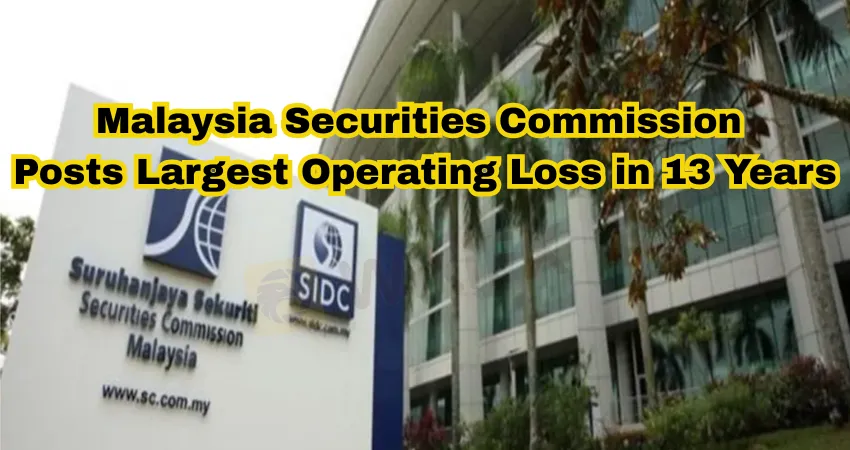
Malaysias Securities Commission (SC) recorded its largest operating loss in 13 years in 2025, posting a deficit of RM66.61 million as weaker market activity sharply reduced income from levies, fees, and compliance charges.
The regulator disclosed the figures in its newly released 2025 Annual Report, showing a sharp reversal from 2024, when it registered an operating surplus of RM20.70 million.
The latest result marks the SCs worst operational performance since 2013 and comes after another significant loss in 2023, when the commission reported an operating deficit of RM56.46 million.
After tax, the SC posted a net operating loss of RM69.32 million in 2025, compared with a net operating profit of RM14 million a year earlier.
The results underscore how closely the SC‘s finances are tied to market activity, as a large portion of its revenue is generated through levies, licensing charges, transaction related fees, and compliance payments from participants in Malaysia’s capital markets.
Total revenue for 2025 came in at RM257.15 million, representing a 16.2 percent decline year on year.
Levies remained the commissions biggest income source, but fell 21.33 percent to RM164.82 million, reflecting softer trading volumes and reduced capital market activity.
Revenue from fees and compliance charges also declined 13.17 percent to RM23.85 million.
Other income contributed RM19.27 million, although this was insufficient to offset the broader decline in core revenue streams.
The latest numbers suggest a slower environment across equities, fundraising activity, and other capital market transactions, all of which directly affect the regulators earnings base.
The losses also highlight the rationale behind the SCs previously announced revision to its fee structure, which officially took effect on 1 January 2026.
Under the revised framework, the regulator introduced a three year transition period featuring discounted charges to ease the burden on market participants while restructuring its revenue model.
The transitional incentives include:
- a 50 percent reduction in variable annual fees
- a 20 percent reduction in transaction fees linked to products, fundraising exercises, and other regulated offerings
The move signals an attempt to modernize the regulators charging system while balancing industry competitiveness and financial sustainability.
However, the discounts may also temporarily limit revenue growth in the short term, especially if market conditions remain subdued.
Staff Costs Remain Largest Expense Item
While income fell sharply, expenditure continued to rise.
The SCs total expenses increased 13.82 percent year on year to RM318.36 million, widening the gap between revenue and operating costs.
Employee related expenses remained the largest cost component, rising 15.34 percent to RM242.29 million.
This means staff costs alone accounted for the majority of the regulators annual spending, highlighting the resource intensive nature of supervision, enforcement, policy development, and market oversight.
Administrative expenses also rose 8.25 percent to RM57.62 million.
As a result, the commissions overall net loss widened to RM85.86 million, compared with RM2.11 million in 2024, representing a nearly 39 fold increase.
Separately, the SC reported a significant drop in court awarded recoveries and civil penalties during the year.
The total value of court ordered disgorgement and civil penalties fell 79.05 percent year on year to RM2.07 million.
Disgorgement recoveries, which refer to gains surrendered following enforcement action, declined 24.62 percent to RM9.08 million.
Compensation amounts, however, rose 6.45 percent to RM1.98 million.
The lower recovery figures may reflect fewer concluded enforcement cases, timing differences in court proceedings, or smaller settlement values during the year.
The SC‘s financial performance does not necessarily reflect its regulatory effectiveness, but it does provide an important indicator of conditions within Malaysia’s broader capital markets ecosystem.
Because the commission relies heavily on transaction linked income, periods of weaker trading volumes, fewer listings, slower fundraising activity, and reduced investor participation can quickly pressure its finances.
For market participants, the report may also be read as a signal that capital raising activity and investor engagement were softer in 2025 than in previous years.
For policymakers, it raises broader questions about whether regulators should remain highly dependent on cyclical market based revenue, especially during periods of volatility or slower economic growth.
With the revised fee structure now in place and a transition period underway, attention will turn to whether market activity rebounds sufficiently in 2026 to stabilize the regulators finances.
A recovery in IPO activity, higher trading volumes, stronger fund flows, and renewed investor confidence could help improve revenue collection.
At the same time, continued inflationary pressure on wages and operating costs may keep expenditure elevated.
For now, the SC enters 2026 facing the challenge of maintaining strong market oversight while navigating its deepest operating loss in more than a decade.

Disclaimer:
The views in this article only represent the author's personal views, and do not constitute investment advice on this platform. This platform does not guarantee the accuracy, completeness and timeliness of the information in the article, and will not be liable for any loss caused by the use of or reliance on the information in the article.
WikiFX Broker
Latest News
How Trading Costs Quietly Drain Your Account: Spreads, Swaps, and Pip Values
WikiFXWhy MetaTrader 4 Remains the Top Choice for Testing Automated Trading Robots
WikiFXeFishery Founder Jailed Nine Years as KWAP Defends RM163 Million Loss
WikiFXGFS Review 2026: Withdrawal Complaints, MT5 Access, and Regulation Gaps
WikiFXLOYAL PRIMUS Review: FSCA-Regulated Broker Faces Mounting Withdrawal Complaints
WikiFXDollar Firms as Geopolitics Pressures Asian Currencies
WikiFXKASPER CAPITAL MARKETS Review 2026: Regulation, Safety, and User Feedback
WikiFXThings About HTFX Broker That You Don't Know About
WikiFXWhy Most Retail Traders Fail: What the Numbers Reveal
WikiFX22K Trader Review 2026: Ongoing User Allegations Raise Fresh Questions About Trust
WikiFX