

Global Broker Regulation Inquiry App
About WikiFX
English
简体中文
繁體中文
English
Pусский
日本語
ภาษาไทย
Tiếng Việt
Bahasa Indonesia
Español
हिन्दी
Filippiiniläinen
Français
Deutsch
Português
Türkçe
한국어
العربية
اردو


Filtering the Forex Economic Calendar for Real Market Moves

WikiFX
|


Abstract:Beginner Forex traders often feel overwhelmed by the endless updates on an economic calendar. This guide explains why you should ignore the noise and focus only on the inflation and employment data that drives central bank interest rates, while warning against the dangers of news-induced slippage.
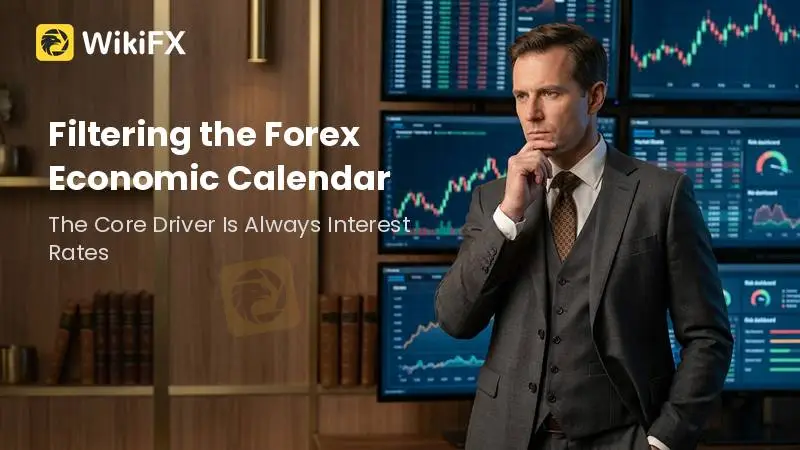
When you first look at a Forex economic calendar, it feels like you need to monitor the market every hour of the day. The screen is filled with color-coded alerts, announcements, and economic data drops from different countries. Many beginners make the mistake of trying to trade every single release, hoping to catch a quick breakout.
This usually leads to stress and unnecessary losses. Fundamental analysis is not about reacting blindly to every new headline. It is about understanding supply and demand, and tracking the specific economic forces that actually change currency prices over time.
Most of the daily updates on your calendar are just noise. To sift through the clutter, you only need to look for the data that influences one major factor.
 Contents
The Core Driver Is Always Interest Rates
In the global currency market, capital flows toward the highest return. If a country offers higher interest rates, foreign investors will buy that country's currency to invest in its financial assets. This increased demand drives the currencys value up.
Central banks, such as the US Federal Reserve, control these interest rates. They raise rates to cool down an overheating economy and cut rates to encourage borrowing when growth stalls. Therefore, the only economic calendar events that truly matter are the ones that might force a central bank to change its interest rate policy. Because the US dollar is involved in the vast majority of global trades, reports coming out of the United States always carry the most weight.
The Heavyweight Data You Should Actually Watch
Instead of staring at minor retail reports or housing updates, focus your attention on the economic health indicators that central banks care about.
Inflation Trackers (CPI and PPI)
The Consumer Price Index (CPI) measures the price changes of everyday goods and services, while the Producer Price Index (PPI) tracks wholesale costs at the manufacturing level. When these numbers rise unexpectedly, it means inflation is getting hotter. To fight high inflation, central banks often raise interest rates.
Employment Data
A healthy economy requires people to be working and spending. Employment rates, particularly the US Non-Farm Payrolls (NFP) report, show the true strength of the labor market. High employment gives a central bank the confidence to keep interest rates high without fear of crashing the economy.
Economic Output (GDP)
Gross Domestic Product measures the total value of goods and services a country produces. It acts as a broad scorecard for overall economic growth. If GDP slows down aggressively, central banks might cut rates to stimulate the market, which generally weakens the country's currency.
When looking at this data on your calendar, remember that the actual number matters less than the markets expectation. If analysts predict inflation will be low, but the CPI suddenly drops a surprisingly high number, the market will react aggressively to the shock.
The Danger of Clicking Buy During an Announcement
Knowing which data matters is only half the battle. Surviving the actual release is the other.
Beginners often try to enter a trade exactly at the minute a major CPI or employment report goes live. This is extremely dangerous due to a mechanical issue called slippage.
During a major news drop, market liquidity evaporates. Prices whip wildly up and down. Because prices are moving in milliseconds, your broker may not be able to execute your market order at the price you clicked. You might attempt to buy EUR/USD at 1.1080, but by the time the order processes a split second later, you are filled at 1.1095. This negative slippage can instantly put your trade in deep drawdown. Professional traders often sit out the initial chaos or rely strictly on limit orders, which only fill at your specified price or better, to avoid being dragged into bad entry points.
Treat your economic calendar as a map for upcoming market volatility, not as a list of guaranteed trade signals. Identify the major inflation and employment reports, understand how they might shift interest rate expectations, and plan your risk accordingly. Because broker execution gets heavily tested during these massive data drops, take a moment to look up your platform on the WikiFX app. Checking their regulatory status and reading user feedback on slippage can save you from finding out your broker cannot handle high-impact news the hard way.

Disclaimer:
The views in this article only represent the author's personal views, and do not constitute investment advice on this platform. This platform does not guarantee the accuracy, completeness and timeliness of the information in the article, and will not be liable for any loss caused by the use of or reliance on the information in the article.
WikiFX Broker
Latest News
BROKSTOCK Review: What Traders Should Know Before Depositing
WikiFXDarwinex Review: Regulated but Office Not Found with Trader Complaints?
WikiFXRBI Ends Deposit Rate Discrimination Between Branches
WikiFXWhy Do Forex Brokers Show Different USD/MYR Quotes?
WikiFXOROKU EDGE Review: Blacklisted by SCM Malaysia and Users Report Frozen Funds
WikiFXStill Trusting Telegram Signals? This Is Why You Are Still Not a Profitable Trader
WikiFXAs Warsh‘s Fed faces pressure to act on inflation, these indicators show it’s at its lowest in years
WikiFXVAULT MARKETS Review: Is Your Deposit Safe?
WikiFXFONDEX Review 2026: Things FONDEX Broker Might Not Want You To See
WikiFXChasing Price: The Psychology That Sinks New Forex Traders
WikiFX