

Global Broker Regulation Inquiry App
About WikiFX
English
简体中文
繁體中文
English
Pусский
日本語
ภาษาไทย
Tiếng Việt
Bahasa Indonesia
Español
हिन्दी
Filippiiniläinen
Français
Deutsch
Português
Türkçe
한국어
العربية
اردو


Neuron Markets Review: Unregulated Broker Risk Behind the Smooth Marketing

WikiFX
|


Abstract:Critical warning: Neuron Markets shows no verified financial regulation, while a 2024 user report alleges a 9-day withdrawal delay and abnormal market moves. For Forex traders, that combination creates a high-risk environment where fund protection is unclear.
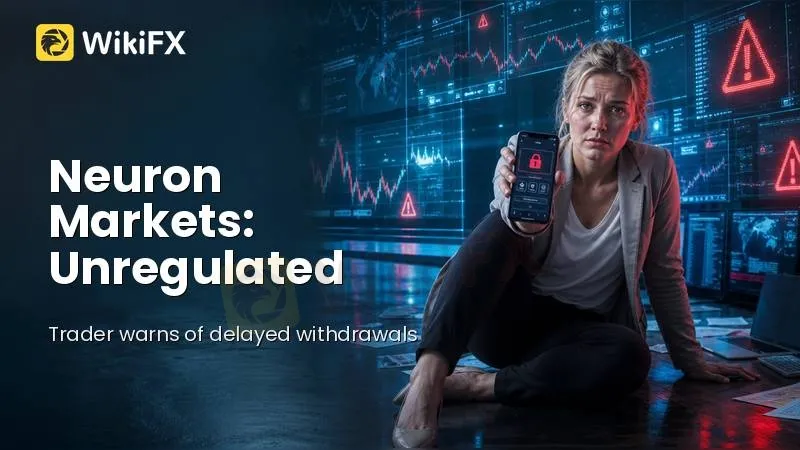
A traders warning cuts through the polished image. In a 2024 review, one user described Neuron Markets as a “fake broker,” claimed a “withdrawal in 9 day,” reported “fake move in the market,” and said the broker was “not regulated.”
That is not a small complaint. It goes directly to the two things retail traders fear most: whether prices are fair, and whether money comes back when requested.
Our investigation into Neuron Markets finds a sharp contrast. Some users praise fast execution, quick deposits, withdrawals, education, and MT5 trading. But the regulatory picture is the real pivot. The broker has no verified financial regulation listed, carries a low WikiFX score of 2.07, and presents high leverage up to 1:500.
For everyday Forex traders, that is a warning sign that cannot be ignored.
 Contents
Regulation Reality Audit: Neuron Markets Has No Verified Oversight
Neuron Markets is listed as established in 2021 and headquartered in Saint Lucia. It offers MT5 trading, four account types, and a low entry threshold starting from $20. It also promotes access through payment channels including bank transfer options, Skrill, Neteller, PerfectMoney, Mastercard, and Visa.
But regulation is the line between a monitored broker and a broker operating without verified supervisory protection. In this case, the regulatory file is empty.
| Regulator | License Type | REAL STATUS |
|---|---|---|
| No regulatory authority found | No verified license found | Unregulated / no valid regulation found |
This matters because regulation is not a decoration. It is the system that can require capital standards, client-money controls, dispute handling, and operational accountability. Without verified regulation, traders have fewer visible protections if withdrawals slow down, pricing is challenged, or support goes silent.
Neuron Markets own profile shows no identified regulator country. The safety assessment also states that no relevant financial institution regulation was found. That is the core risk.
Neuron Markets Broker Review: The Complaint That Changes the Picture
The strongest risk signal comes from the May 2024 user exposure. The trader alleged three issues in one report: delayed withdrawal, fake market movement, and a difference between the brokers platform and TradingView.
The user also urged others to check deposit request time and withdrawal time. That detail matters. A delayed withdrawal complaint is not just about impatience. It can point to stress in back-office processing, unclear approval rules, or poor client-service handling.
The reported delay was “9 day.” We cannot add facts beyond that. But the allegation alone deserves attention because this broker does not have verified regulatory oversight shown in the file.
There is also a pricing concern. The user claimed a difference between the broker and TradingView, plus “fake move in the market.” In Forex trading, price-feed confidence is essential. If a trader believes the chart behaves differently from external references, the relationship breaks down fast.
This is why the absence of regulation makes the complaint heavier.
Visual Evidence: 2024 Case Material Exists, But No Current-Year Placeholder Applies
The available case material includes image URLs attached to 2024 user posts. The May 2024 exposure included three images, while several July, August, and September 2024 posts also carried images.
No current-year case item is included in the provided complaint set. For that reason, no current-year visual evidence placeholder is inserted here.
The Mixed Reviews Do Not Erase the Risk
To be fair, not every user report is negative. Several 2024 posts praised Neuron Markets.
One Pakistan-based user wrote that entry execution had “no extra delay” and that data appeared to be real time. Another user said they had traded with Neuron Markets for almost two years, claimed payments were completed on time, and said they saw no artificial spike. Other users praised free Forex education, market analysis, signals, support, and quick deposits and withdrawals.
Those comments are part of the record.
But a broker review cannot stop at positive experiences. The question is not whether some users felt satisfied. The question is what happens when something goes wrong.
In regulated environments, traders may have a clearer route for complaints. With Neuron Markets, our investigation found no verified regulator in the available record. That means the trader is left relying heavily on the brokers internal process.
That is a weak position for the client.
Trading Conditions Look Attractive, But They Increase Exposure
Neuron Markets offers four account types: STARTER, Islamic, Pro, and STANDARD. The STARTER account begins at $20, while other accounts show entry conditions of $100 or $500. The maximum leverage listed is 1:500.
High leverage can look attractive to new traders. It can make a small deposit feel powerful. But it also increases the speed at which losses can occur, especially in volatile Forex markets.
The broker uses MT5, a widely known trading platform. Its profile lists MT5 qualification as a main-standard MT4/5 platform setup. The platform environment is described as customizable, multilingual, and offering clear fee reports.
Still, good software does not replace regulation. A polished trading terminal cannot guarantee fair execution, withdrawal certainty, or dispute protection.
That is the point many traders miss.
Customer Service Exists, But Oversight Is Still the Main Gap
Neuron Markets lists multiple customer-service channels. These include phone numbers, email support, WhatsApp, Facebook, X, Instagram, YouTube, and LinkedIn. English support is listed, with service exposure across regions including the United Arab Emirates and Mauritius.
That may create a sense of accessibility. But access to support is not the same as accountability.
The profile notes that answers may be received, but waiting time could be long. When a trader is waiting for a withdrawal, a slow support process can intensify pressure. When there is no verified regulator visible in the background, that pressure becomes a major risk factor.
Key Red Flags Traders Should Not Ignore
- No verified financial regulation found for Neuron Markets in the available regulatory record.
- Low WikiFX score of 2.07, indicating a weak overall risk profile.
- A 2024 user alleged a 9-day withdrawal delay and challenged market movement on the platform.
- High leverage up to 1:500, which can sharply increase retail trader exposure.
Is Neuron Markets Broker Safe for Forex Traders?
Based on the available record, Neuron Markets presents a high-risk profile for cautious traders. The broker has a working website, MT5 access, several account types, and multiple positive user comments. But the absence of verified regulation is the decisive issue.
A single negative report does not define every client experience. But a withdrawal-delay allegation attached to an unregulated broker is serious. A pricing-discrepancy allegation in the same report makes it more serious.
Traders should not be distracted by low deposits, education offers, or friendly support channels. These features may be useful, but they do not solve the protection gap.
The verdict is clear: Neuron Markets may look accessible, but the regulatory foundation is missing. For retail Forex traders, that means caution is not optional. It is the first line of defense.

Disclaimer:
The views in this article only represent the author's personal views, and do not constitute investment advice on this platform. This platform does not guarantee the accuracy, completeness and timeliness of the information in the article, and will not be liable for any loss caused by the use of or reliance on the information in the article.
WikiFX Broker
Latest News
British Pound edges higher as USD softens ahead US jobs data
WikiFXAustralian Dollar holds firm amid hawkish Fed and RBA expectations
WikiFXEuro: Limited downside, range defined against US Dollar – Scotiabank
WikiFXUSD/JPY Forecast: Retreats from one-month high but dip-buying eyed
WikiFXCanadian Dollar strengthens despite hawkish Fed rhetoric
WikiFXForex Today: Attention shifts to US ISM, JOLTs and inflation in Europe
WikiFXPolish Zloty: Fiscal slippage and cautious NBP weigh – Commerzbank
WikiFXJapanese Yen: Supported below 160 against US Dollar – Scotiabank
WikiFXJapanese Yen: BoJ normalization expectations and contained moves – BNY
WikiFXEuro holds gains above 1.1600 ahead of Eurozone HICP inflation data
WikiFX