

Global Broker Regulation Inquiry App
About WikiFX
English
简体中文
繁體中文
English
Pусский
日本語
ภาษาไทย
Tiếng Việt
Bahasa Indonesia
Español
हिन्दी
Filippiiniläinen
Français
Deutsch
Português
Türkçe
한국어
العربية
اردو


Why Your Forex Withdrawal Triggers AML Alerts – The Real Checks

WikiFX
|


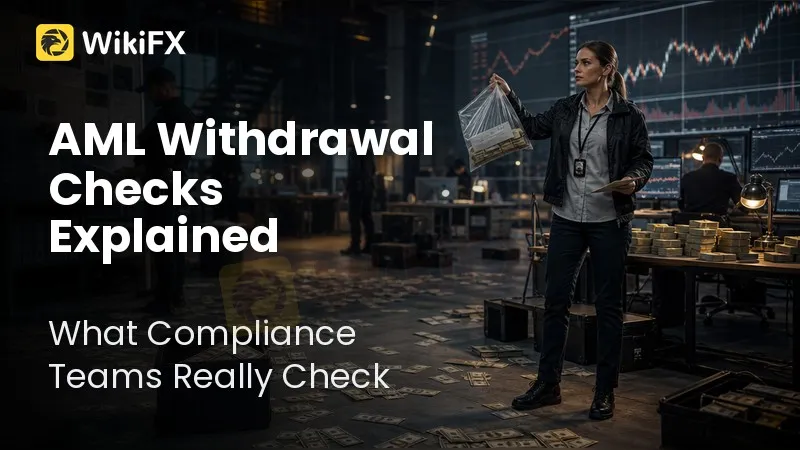
Abstract:AML screening in forex is not about blocking your profits but about verifying the legitimacy of your funds. Learn what compliance teams actually check during cross‑border deposits and withdrawals, and how to avoid delays without breaking any rules.
 Contents
What is AML Screening and Why Does It Block My Transfer?
Anti‑Money Laundering (AML) screening is a set of legal procedures that forex brokers use to detect and prevent illegal money flows. When you deposit or withdraw funds across borders, the transaction passes through a compliance filter. This is not the broker being difficult, it is a regulatory requirement. In most African jurisdictions, regulators demand that financial firms know exactly who their clients are and where their money comes from. If you have ever had a withdrawal delayed with a request for documents, you have felt the AML process at work.
New traders often panic. They see a frozen account and suspect theft. The truth is simpler: the brokers computer system or a human reviewer spotted something that did not match your usual profile. It could be a sudden large deposit, a new bank account, or a transfer from a country with a higher risk rating. These alerts are not verdicts; they are invitations to provide extra proof.
The KYC Framework: The Foundation of Every AML Check
To understand AML, you first need to understand Know Your Customer (KYC). KYC is the identity‑verification step you complete when opening a forex account. You submit a government‑issued ID, proof of address, and sometimes a bank statement. This creates a baseline profile: your name, residence, occupation, and estimated income. Later, every transaction is measured against that profile.
AML takes KYC a step further. While KYC tells the broker who you are, AML asks: “Does this transaction make sense for this person?” A farmer with a modest monthly income should not be wiring a million dollars from an offshore company. Even if that million dollars is legitimate, it raises a red flag that demands explanation. For cross‑border transfers, AML checks look at the sender, the receiver, the amounts, the countries involved, and the pattern of behaviour.
What Triggers a Deeper Investigation? A Closer Look at Red Flags
Compliance teams do not stop every transfer. They rely on automated systems that score transactions by risk. When a transaction exceeds a threshold, a human reviewer steps in. Here is a hypothetical example to illustrate the process.
Imagine a trader, let us call him Kofi, who has been trading a small live account for six months. He deposits between $100 and $300 each month from his local bank in Accra. One day, he receives a large payment from a business partner abroad and decides to deposit $10,000 into his trading account. Because this deposit is ten times his usual size and comes from a new bank account in a different country, the broker‘s system flags it. Kofi’s subsequent withdrawal request is placed on hold, and he receives an email asking for additional documents: a bank statement showing the source of the $10,000, a letter explaining his relationship with the sender, and a recent utility bill to reconfirm his address.
This scenario touches several common triggers:
- Unusual transaction size: A sharp jump in deposit amount compared with historical behaviour.
- New funding source: A bank account or payment method that has never been used before.
- Inconsistent profile: The transaction does not align with the clients declared income or occupation.
- High‑risk geography: Transfers to or from countries with weak anti‑money‑laundering controls.
Other red flags include frequent small deposits immediately followed by a large withdrawal, third‑party payments (where the name on the sending account differs from the account holder), and complex multi‑step transfers designed to obscure the trail of funds. Every regulated broker must investigate such signals, they risk heavy fines or losing their licence if they do not.
Common Misconceptions About AML Holds
Misunderstanding why a transfer is held can lead to needless frustration. Here are some myths debunked.
- “The broker is stealing my money.” A frozen transaction is not confiscation. Your funds remain in your account; the broker only delays the movement until verification is complete. Regulators monitor client‑fund protection closely.
- “If I send the documents, my money will be released instantly.” Compliance officers often take several business days to review submissions, especially if they need to consult an external fraud database. Patience is normal.
- “AML checks apply only to large traders or suspicious characters.” Every client is subject to the same rules. Regulators do not permit selective oversight.
- “It is a tactic to delay payments for interest or cash‑flow reasons.” The cost of non‑compliance, millions in fines or even loss of licence, far outweighs any temporary benefit from holding client funds.
- “Once I pass KYC, I will never be asked for documents again.” KYC is a one‑time setup; AML is ongoing. Brokers must periodically re‑verify clients, especially when transaction patterns change.
The Bottom Line: What AML Checks Are – and Are Not
AML screening is a shield, not a sword. It verifies the legitimacy of funds, not the quality of your trades. It does not predict market movements, assess your strategy, or guarantee a brokers financial health. When you encounter an AML hold, view it as a routine compliance step, an inconvenience, yes, but also a sign that your broker is operating within a regulated framework that protects the entire financial system.
Understanding this process helps you respond calmly and prepare the right documents, so you can get back to trading with confidence.
Disclaimer:
The views in this article only represent the author's personal views, and do not constitute investment advice on this platform. This platform does not guarantee the accuracy, completeness and timeliness of the information in the article, and will not be liable for any loss caused by the use of or reliance on the information in the article.
WikiFX Broker
Latest News
Apple Faces Lawsuit Over Fake Crypto App Exposing $1.8 Million Theft
WikiFXTrump Memecoin Faces SEC Scrutiny After Nearly One Million Investors Suffer Heavy Losses
WikiFX"They Want to See Your Face": Inside ATFX Cambodia's Rise
WikiFXSpread Cheating: The Invisible Trading Cost That Could Be Working Against You
WikiFXLevels Review: No Regulation and Mounting Withdrawal Complaints – What Traders Need to Know
WikiFXLQH MARKETS Review: Multiple Traders Report Withdrawals Blocked and Accounts Terminated
WikiFXBorn2trade Adds Copy Trading to 1:5000 Leverage Platform
WikiFXPILOTFX Review: What Traders Should Know Before Depositing
WikiFXLMAX Group Review 2026: Users Report Disturbing Withdrawal Issues - Is the Broker Still Reliable?
WikiFXTrade24Seven Review: What Traders Should Know Before Depositing
WikiFX