PU Prime Launches “The Grind” to Empower Traders
Discover PU Prime’s new campaign, “The Grind,” and learn how trading discipline builds long-term success. Watch and start your trading journey today!
简体中文
繁體中文
English
Pусский
日本語
ภาษาไทย
Tiếng Việt
Bahasa Indonesia
Español
हिन्दी
Filippiiniläinen
Français
Deutsch
Português
Türkçe
한국어
العربية
Abstract:Robinhood announced the suspension of its 24-hour overnight trading service due to the severe market downturn on Monday, August 5.
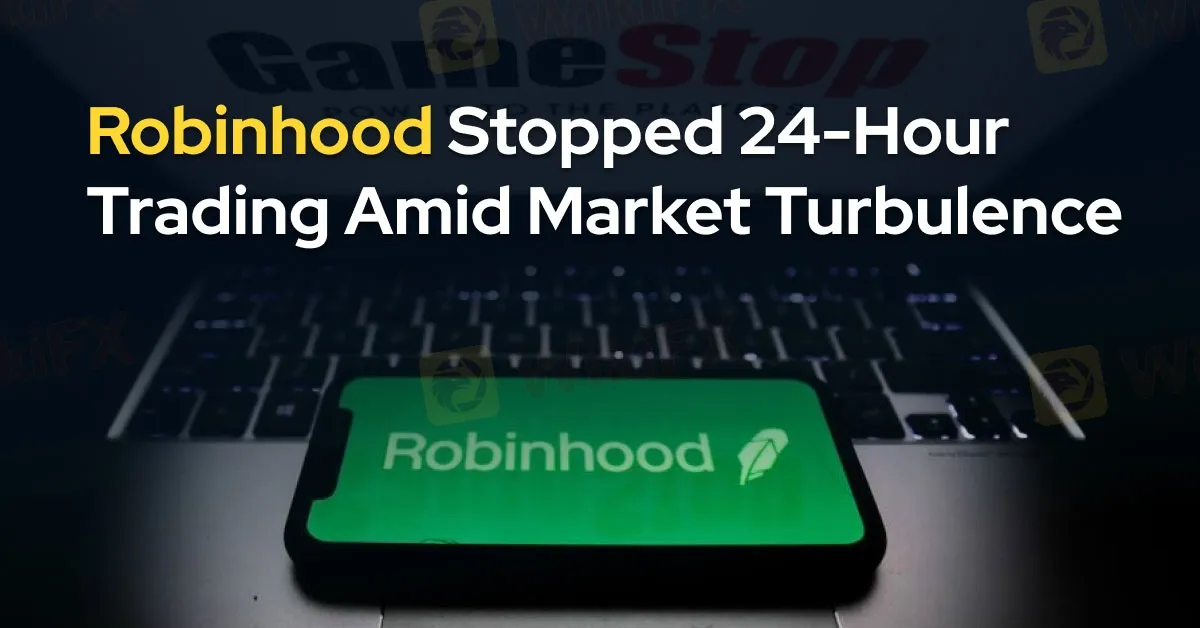
Robinhood (NASDAQ:HOOD), a leading US neobroker, has announced the suspension of its 24-hour overnight trading service due to the severe market downturn on Monday, August 5. This service will be unavailable through Tuesday, August 6.
The market faced a steep decline on Monday, with the Dow Jones Industrial Average plummeting more than 1,000 points, a 2.6% drop. The broader S&P 500 and technology-heavy NASDAQ indices saw even sharper declines of 3.0% and 3.4%, respectively. Cryptocurrencies also took a hit, with Bitcoin and Ether prices dropping significantly.
In a statement on X (formerly Twitter), Robinhood explained that its overnight trading platform, Blue Ocean ATS (BOATs), would be offline for the night. Orders placed before approximately 8 PM ET will resume processing around 4 AM ET the following morning. Users can cancel their orders anytime and place new ones for the next trading session.

The market turmoil extended to Japan, where stocks experienced a dramatic 13% drop, the largest since the 2011 global financial crisis. This sharp sell-off led to circuit breakers being triggered across Asian exchanges. The Asia-Pacific index, excluding Japan, fell by 4.2%, while Japan's Nikkei 225 index hit a seven-month low.
In the United States, the negative trend continued with Nasdaq futures down 4.7% and S&P 500 futures plunging 12.4%. European markets were also affected, with EUROSTOXX 50 futures falling 2.1% and FTSE futures dropping 1.2%.
Investors turned to safer assets, causing both the yen and Swiss franc to strengthen. Japanese 10-year bond yields fell to 0.785%, the lowest since April, and U.S. Treasury yields also dropped significantly, with 10-year yields at 3.723% and two-year yields at 3.807%. This inversion of the yield curve is often seen as a recession indicator.
Following a disappointing July payrolls report, market expectations for Federal Reserve rate cuts have surged. Analysts now predict a 78% chance of a rate cut in September, with further reductions expected later in the year. Goldman Sachs has raised its recession probability to 25% under current conditions.
The U.S. dollar's appeal as a safe haven weakened, falling 0.4% against a basket of major currencies. It also declined against the yen and euro, while the Swiss franc appreciated. Gold prices climbed to $2,456 an ounce as investors sought refuge in precious metals.


Disclaimer:
The views in this article only represent the author's personal views, and do not constitute investment advice on this platform. This platform does not guarantee the accuracy, completeness and timeliness of the information in the article, and will not be liable for any loss caused by the use of or reliance on the information in the article.

Discover PU Prime’s new campaign, “The Grind,” and learn how trading discipline builds long-term success. Watch and start your trading journey today!

IG boosts FCA compliance by integrating Adclear’s AI tools. Learn how automation accelerates marketing approvals and ensures regulatory accuracy.

A close look at ZarVista's regulatory status shows major red flags that mark it as a high-risk broker for traders. This analysis goes beyond the company's marketing materials to examine the real substance of its licenses, business structure, and operating history. The main issues we will explore include its dependence on weak offshore regulation, a large number of serious user complaints, and worrying details about its corporate identity. It is also important to note that ZarVista previously operated under the name Zara FX, a detail that provides important background to its history. This article aims to deliver a complete, evidence-based breakdown of the ZarVista license framework and its real-world effects, helping traders understand the serious risks involved before investing.

When traders think about choosing a new broker, two main questions come up: Is ZarVista safe or a scam? And what are the common ZarVista complaints? These questions get to the heart of what matters most—keeping your capital safe. This article gives you a detailed look at ZarVista's reputation using public information, government records, and real experiences from people who used their services. Our research starts with an important fact that shapes this whole review. WikiFX, a website that checks brokers independently, gives ZarVista a trust score of only 2.07 out of 10. This very low rating comes with a clear warning: "Low score, please stay away!" The main reason for this low score is the large number of user complaints. This finding shows that ZarVista might be risky to use. To get the complete picture, we will look at the broker's government approval status, examine the specific complaints from users, check any positive reviews to be fair, and give you a final answer based on fact