


Global Broker Regulation Inquiry App
About WikiFX
English
简体中文
繁體中文
English
Pусский
日本語
ภาษาไทย
Tiếng Việt
Bahasa Indonesia
Español
हिन्दी
Filippiiniläinen
Français
Deutsch
Português
Türkçe
한국어
العربية
اردو
Trade Wars & Alliances: EU-India Seal 'Century Deal' as Trump Targets Korea
Abstract:As the EU and India sign a historic trade pact to hedge against protectionism, South Korea scrambles to respond to Trump's latest 25% tariff threat on automobiles.
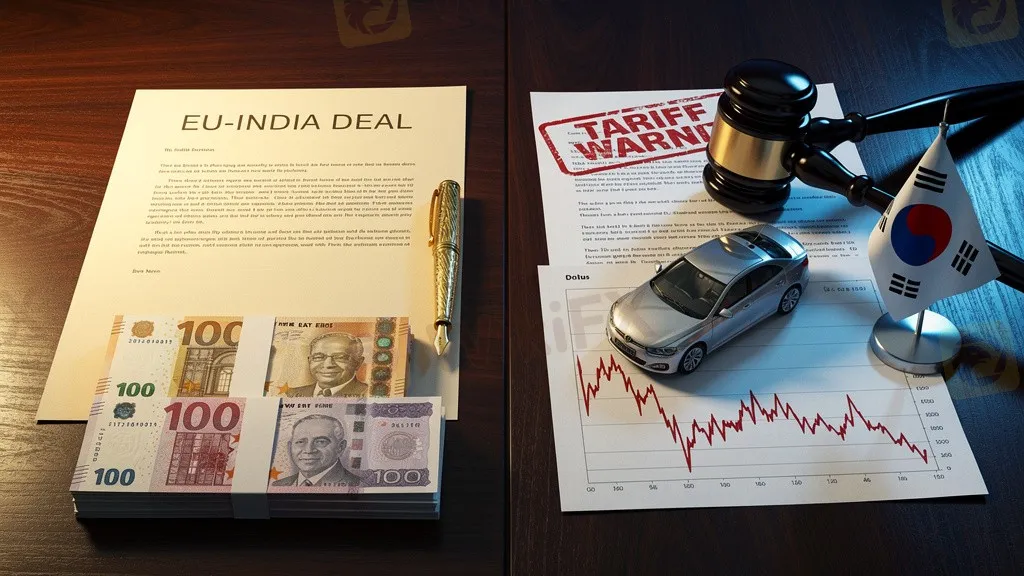
Global trade dynamics are bifurcating rapidly. While Europe and India solidified economic ties with a historic free trade agreement this week, the United States has reignited volatility in the Pacific rim with fresh tariff threats against South Korea.
The 'Century Deal': EU and India Pivot
After 20 years of negotiations, the European Union and India signed a landmark trade agreement on Tuesday, slashing tariffs on over 90% of traded goods. The deal, expected to create a free trade zone covering 2 billion people by 2026, is widely viewed as a strategic hedge against US protectionism and Chinese dominance.
- India will lower duties on European automobiles, wines, and machinery.
- The EU grants zero-tariff access to Indian textiles, leather, and jewelry—sectors previously hit hard by US punitive tariffs.
- US Reaction: The White House has expressed dissatisfaction, with officials criticizing the EU for cutting a deal while India continues to purchase Russian oil.
Seoul in Panic Mode
Conversely, geopolitical tensions spiked in Asia after President Trump threatened a 25% tariff on South Korean automobiles, citing the country's failure to fast-track specific investment legislation. The announcement caused immediate tremors in Seoul, with Kospi-listed automakers like Hyundai and Kia seeing sharp equity sell-offs.
South Korean officials have launched emergency inter-agency meetings and plan to dispatch trade envoys to Washington immediately to prevent the tariffs from taking effect.
The 'Bluff' Factor
Despite the immediate market anxiety, data from Bloomberg Economics suggests investors should remain level-headed. An analysis of Trump's first months back in office reveals that only 25% of his tariff threats have been fully implemented, while over 40% have been withdrawn or watered down. The prevailing consensus among seasoned FX traders is that the threats are primarily leverage for negotiation rather than immovable policy, though the short-term volatility for the Korean Won (KRW) remains acute.
Disclaimer:
The views in this article only represent the author's personal views, and do not constitute investment advice on this platform. This platform does not guarantee the accuracy, completeness and timeliness of the information in the article, and will not be liable for any loss caused by the use of or reliance on the information in the article.
WikiFX Broker
Latest News
Hero FX Review 2026: Is This Forex Broker Safe?
 WikiFX
SpaceMarket Review 2026: Is This Forex Broker Safe?
WikiFXCONSOB Blocks 21 Unauthorized Websites as Online Trading Risks Continue
WikiFXCurrency Calculator
USD

CNY
Current Rate:0
Enter amount
USD
Redeemable Amount
CNY
Calculate 