Abstract:For any trader doing research, the main question is always about safety and whether a broker is legitimate. When it comes to AssetsFX, the information shows a clear and worrying picture right from the start. This summary gives you the most important findings first, so you can understand the risks right away. Read on!
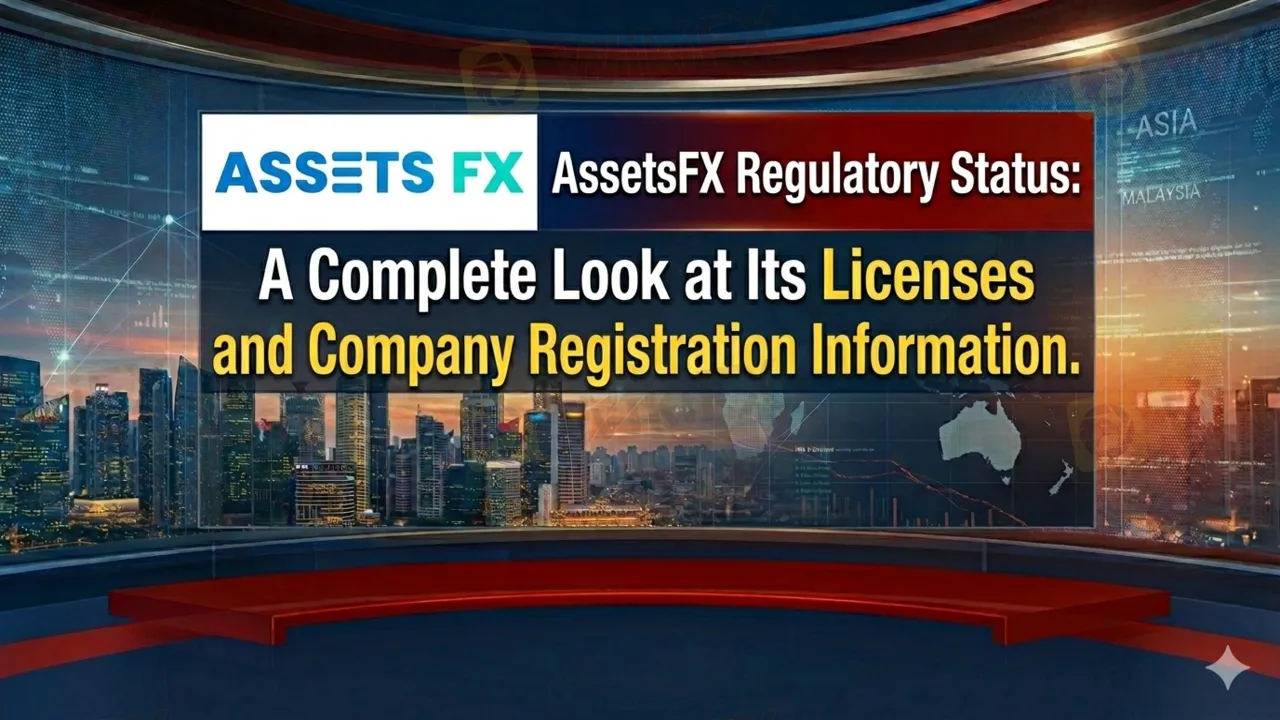
Executive Summary: Key Findings
For any trader doing research, the main question is always about safety and whether a broker is legitimate. When it comes to AssetsFX, the information shows a clear and worrying picture right from the start. This summary gives you the most important findings first, so you can understand the risks right away.
The Watchdog Verdict
The most direct answer to the question “Is AssetsFX regulated?” comes from combined data on independent regulatory research platforms. Based on a complete review, the verdict is harsh.
> Critical Data Points on AssetsFX:
> * Regulatory Status: Marked as “No Regulation.”
> * Safety Score: An extremely low 2.44 out of 10.
> * Official Warnings: Clear alerts such as “High potential risk” and “Warning: Low score, please stay away!” are shown prominently.
> * License Tag: Marked with “Suspicious Regulatory License.”
These are not personal opinions; they are conclusions based on data from the broker's company structure, licensing (or lack of it), and operating history. A score this low is a major and immediate warning sign, showing basic problems with the broker's trustworthiness and safety measures.
What This Means for You
A lack of valid regulation is not just a technical detail; it has serious practical consequences for you as a trader. It means:
· No Fund Protection: Your capital is not kept separate in top-quality banks or protected by any investor compensation program. If the broker goes bankrupt or acts dishonestly, your funds are at high risk of being lost completely.
· No Dispute Resolution: If you have a problem regarding trade execution, pricing or withdrawals, there is no independent regulatory body to appeal to. You are left to deal with the broker directly, who holds all the power.
· High Risk of Fraud: Unregulated companies operate outside the law, making them a breeding ground for fraudulent activities such as price manipulation, refusing to process withdrawals, and outright theft.
The conflicting and alarming data surrounding AssetsFX show the critical need for careful research. Before considering any broker, it is essential to use a complete verification tool. We strongly advise traders to check the detailed report on platforms, such as WikiFX, to see this evidence for themselves.
Breaking Down the “License”
To understand the full scope of the risk, we must examine the contradictory information AssetsFX presents about its own licensing. This is a common tactic used by high-risk brokers to create a false appearance of legitimacy.
The Offshore License Claim
AssetsFX, operating under the company name Assets Global Ltd, claims to be registered in Mauritius. The company profile suggests it has been operating for 10-15 years. Some materials associated with the broker claim it holds a license from the Financial Services Commission (FSC) of Mauritius. This is often positioned to give traders a false sense of security.
Reality of Offshore Regulation
It is crucial to understand the huge difference between a top-tier regulator and an offshore one. A top-tier regulator (such as the UK's FCA or Australia's ASIC) imposes strict rules on capital requirements, client fund separation, and business conduct. An offshore regulator, such as the FSC in Mauritius, while providing a legal framework, offers significantly weaker protections.
Here's where the most significant red flag appears: The very same profiles that mention a potential FSC license are simultaneously dominated by a “No Regulation” warning and a “Suspicious Regulatory License” tag. This contradiction is not an error; it is often a deliberate strategy. The broker uses the name of a regulator to appear legitimate while failing to meet the standards required for a clean bill of health from watchdog platforms. This creates confusion and targets traders who may not understand the differences between regulatory tiers.
To clarify, here is a comparison:
The Indonesian Warning
Adding to the list of concerns is a disclosure from Indonesia's commodity futures trading regulator, BAPPEBTI. The agency announced it had blocked access to hundreds of illegal commodity futures trading websites. While AssetsFX is not named directly in the provided snippets, the inclusion of this warning in the “Disclosure” section on its profile on watchdog sites is another negative signal. It suggests the broker may be operating in jurisdictions where it is not authorized, attracting the attention of local regulators for the wrong reasons.
Looking at User Experiences
Data and licenses tell one part of the story. The real-world experiences of other traders provide the most powerful evidence of a broker's true nature. In the case of AssetsFX, the user feedback is deeply split and reveals severe, credible accusations.
Serious Accusations from Users
The “Exposure” section on platforms, such as WikiFX, is a collection of user-submitted complaints. For AssetsFX, these are not minor complaints; they are detailed accusations of financial misconduct.
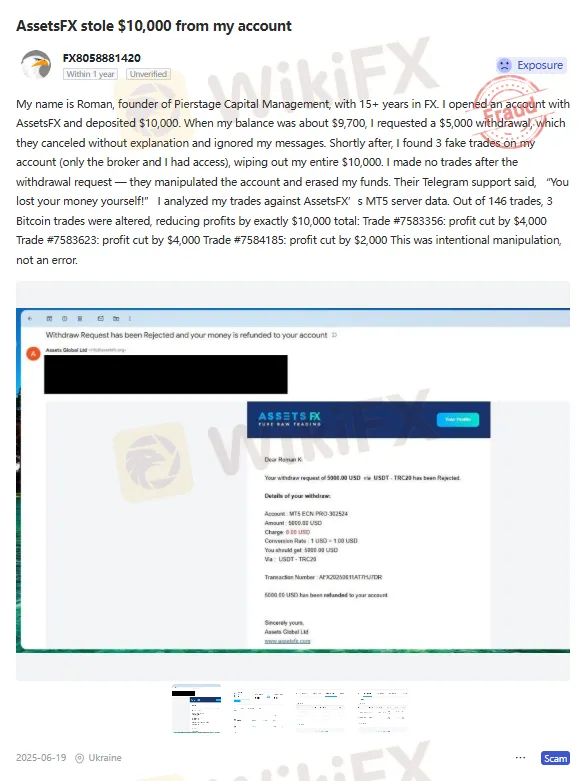
· Case 1: The $10,000 Theft and Manipulation. A user named Roman, identifying as a 15-year FX veteran and fund founder, reported depositing $10,000. When he attempted to withdraw $5,000, the request was canceled without explanation. Shortly after, he discovered three fake trades had been executed on his account, wiping out his entire balance. He claims these were not his trades and provides a detailed analysis claiming that profit on three specific Bitcoin trades was intentionally changed on the server side to reduce his account by exactly $10,000. This is a specific and damning accusation of direct trade manipulation and theft.
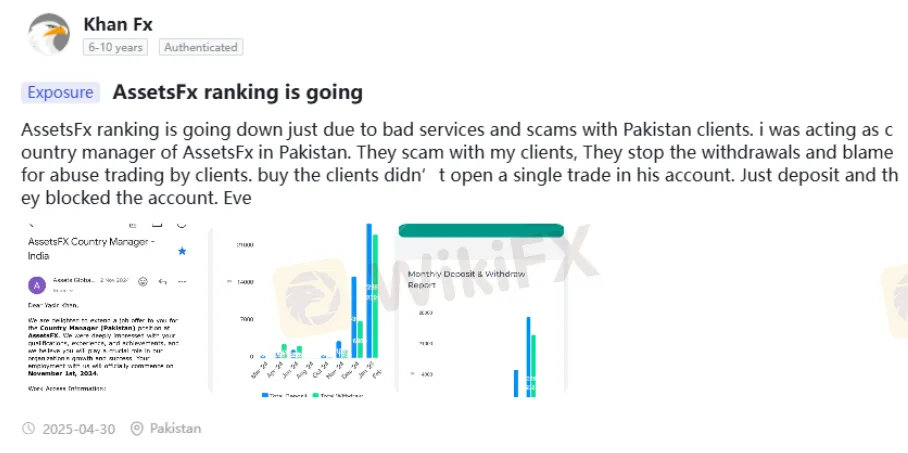
· Case 2: The Insider Whistleblower. An even more alarming report comes from a user identifying as the former “country manager of AssetsFx in Pakistan.” This individual claims a systematic scam against clients. According to the report, the broker would block client accounts immediately after a deposit was made, then falsely blame the client for “abuse trading” to justify withholding funds, even if the client had not opened a single trade. An accusation from a supposed insider is one of the most serious red flags a broker can have.
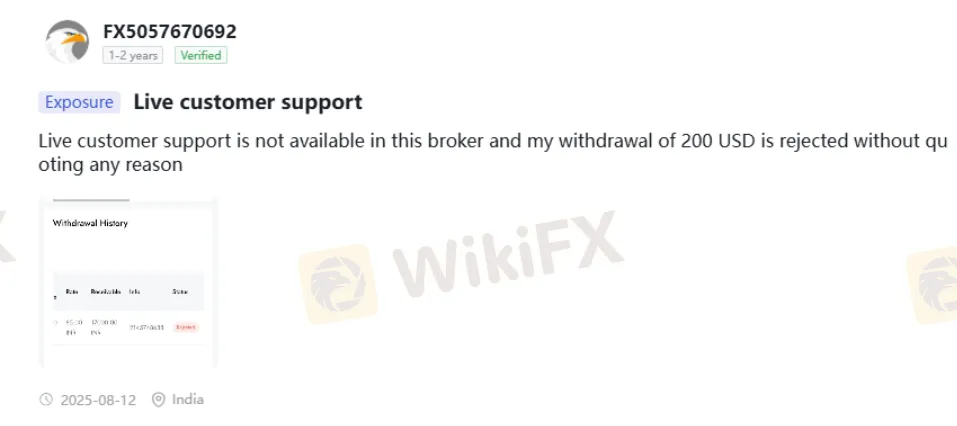
· Case 3: The Simple Withdrawal Rejection. A verified user from India filed a much simpler, but equally concerning, complaint. Their withdrawal request for $200 was rejected without any reason provided, and they found that the live customer support was unavailable to resolve the issue. This demonstrates that even for small amounts, withdrawal processes can be a major problem.
A Suspicious Review Pattern
Contradicting these severe allegations is a large volume of positive reviews. Out of 110 reviews on one platform, 95 are positive. However, a critical analysis of these reviews reveals a suspicious pattern.
First, the language is overwhelmingly generic and vague. Comments like “does the job well,” “quietly reliable,” and “smooth performance” are common. They lack the specific details, trade numbers, or support ticket references that often accompany genuine, enthusiastic feedback.
Second, there is a stark geographic concentration. A vast majority of these positive reviews originate from a single country, Bangladesh. While not definitive proof of wrongdoing, such a pattern can be an indicator of an artificial or incentivized review campaign designed to bury negative feedback.
This combination—a flood of generic praise paired with a handful of highly detailed, severe accusations of fraud—is a massive red flag. In our experience, it is the specific, detailed complaints that carry more weight, as they are harder to fabricate and often contain verifiable information.
The stark contrast between glowing praise and detailed accusations of theft is alarming. This is why cross-referencing user reviews on a neutral platform like WikiFX is crucial to see the full, unfiltered picture.
Company Profile vs Reality
High-risk brokers often invest heavily in marketing to create an image of trustworthiness that is not supported by their business practices. Breaking down this marketing narrative is key to seeing the broker for what it is.
A Polished Public Image
AssetsFX's news feed is filled with announcements celebrating its participation in major industry events like the Dubai Forex Expo 2024 and Money Expo Qatar 2024. Most notably, the broker was reportedly honored with the “Most Trusted Forex Broker - Asia” award at the WIKI FINANCE EXPO Dubai 2024.
This creates a dangerous disconnect for the average trader. How can a broker with such a low safety score and accusations of theft be winning a “most trusted” award? This contrast highlights the importance of relying on objective data over marketing materials.
The Technical Facade
AssetsFX offers what appear to be standard, professional-grade tools. It provides access to the popular MT4 and MT5 trading platforms and offers a tiered account structure, from a Standard account with a $10 minimum deposit to a ZERO ECN account requiring $5,000.
However, these features are nothing more than a technical facade. A sophisticated platform, tight spreads, and high leverage are completely meaningless if the broker behind them is untrustworthy. These tools provide no protection if the broker can unilaterally manipulate your trades, block your account, or simply refuse to return your funds. The foundation of trading is trust, and that foundation is built on AssetsFX regulation and verifiable broker conduct, not on the trading platform it offers.
Final Verdict: A High-Risk Broker
After a thorough review of the available data, user experiences, and regulatory information, our conclusion is clear.
Summary of Critical Red Flags
To summarize, AssetsFX shows a pattern of behavior and a company structure consistent with a high-risk, untrustworthy operation. The key red flags are:
· No Credible AssetsFX Regulation: The broker is flagged for “No Regulation” and carries an extremely low safety score of 2.44/10.
· Misleading AssetsFX License Claims: Information about its offshore license is contradictory and marked as “suspicious” by independent analysts.
· Severe User Allegations: There are multiple, detailed, and credible accusations of fund theft, trade manipulation, and blocking withdrawals, including a report from a supposed insider.
· Suspicious Review Patterns: A large volume of generic positive reviews from a concentrated geographic area serves to hide the severe negative complaints.
· Marketing vs Reality: The broker's public image and awards are in direct and stark opposition to its regulatory status and the reported user experiences.
Our Recommendation for Traders
Given the overwhelming evidence of high risk, we cannot, under any circumstance, suggest that a trader's funds would be safe with AssetsFX. The combination of no meaningful regulation and credible accusations of fraudulent activity makes it a broker that should be avoided by all traders, regardless of their experience level or risk tolerance.
The case of AssetsFX is a powerful reminder that a broker's marketing, website claims, and even awards cannot be trusted at face value. Before depositing with *any* broker, your first and most crucial step should always be to perform a thorough check on an independent regulatory inquiry platform. We strongly urge all traders to use WikiFX to verify a broker's regulatory status and review unfiltered user feedback before making any financial commitment. Your capital is too important to risk on a foundation of red flags and broken trust.
Download the WikiFX app to verify brokers regulatory status and other details.

More Insightful Articles for You to Read
on Trading: Wrong NZ
FMA Authorization Claims, Non-stop User Allegations