

Applicazione di richiesta di informazioni sulla regolamentazione dei broker globali
WikiFX
English
简体中文
繁體中文
English
Pусский
日本語
ภาษาไทย
Tiếng Việt
Bahasa Indonesia
Español
हिन्दी
Filippiiniläinen
Français
Deutsch
Português
Türkçe
한국어
العربية
Federal Reserve Power Reshuffle and a New Tariff Landscape
Sommario:U.S. political and economic signals have once again moved to the forefront of global market attention. Former President Trump made unusually explicit remarks regarding the selection of the next Federa
U.S. political and economic signals have once again moved to the forefront of global market attention. Former President Trump made unusually explicit remarks regarding the selection of the next Federal Reserve Chair, stating that a clear willingness to “cut rates” will be a key test for any candidate. He also suggested that the administration is evaluating adjustments to the tariff framework—not only on items such as coffee, beef, and bananas, but potentially across a broader range of consumer goods. For the first time, Trump hinted that some tariffs may be lowered while others could be raised, signaling a possible expansion of tariff exemptions ahead.
Meanwhile, the administration is entering the final stage of selecting its preferred nominee for Fed Chair. Media reports indicate that Kevin Hassett remains one of the leading contenders, while Trump and Treasury Secretary Bessent are scheduled to meet with Kevin Warsh. Discussions inside the administration reportedly include the possibility of appointing Hassett to a shorter-than-usual term to preserve policy flexibility. Hassett has taken a relatively dovish stance on rate cuts, arguing that the Fed currently has “ample room” to reduce rates by more than 25 basis points. However, he emphasized that if inflation rises from 2.5% to 4%, conditions would no longer justify rate cuts. He also stressed that, should he become Chair, he would maintain independent judgment—an approach Trump has publicly stated he respects.
Labor-market data ahead of the rate decision showed a mixed structural picture.
ADP data indicated that small- and medium-sized businesses ended a four-week streak of net job losses, adding an average of 4,750 jobs per week—an encouraging sign of stabilization. Conversely, the JOLTS report showed job openings unexpectedly rising to a five-month high, while hiring dropped more than 4%, layoffs surged to 1.85 million—the highest since early 2023—and the quits rate fell to a five-year low. The combination suggests the labor market is cooling, but not as weak as alternative data had implied. Most economists now believe the labor market is no longer a primary driver of inflation, giving the Fed some room to remain patient on policy.
In the bond market, the Treasurys $39 billion auction of 10-year notes saw strong demand, with indirect bidders—largely foreign institutions—taking 70.2%, a four-month high. The bid-to-cover ratio rose to 2.550. Yet despite the strong auction, Treasury prices failed to rally. Instead, yields moved sharply higher intraday after the unexpected jump in JOLTS job openings, with the 10-year yield nearing a two-month high. The market reaction underscores the delicate policy backdrop: mixed economic signals continue to place the Fed in a difficult position between inflation, employment, and the timing of potential rate cuts.
Overall, the political direction of the U.S. and evolving macroeconomic data indicate that the next several months will be pivotal for global markets. The selection of the next Fed Chair, the pace of rate cuts, and potential tariff adjustments will all shape the inflation outlook, funding costs, and global trade dynamics. While employment and inflation data continue to diverge, both point to an economy entering a more nuanced and fragile adjustment phase. Investors are now waiting for policy clarity from the new administration and a new Federal Reserve leadership. In an environment of rising uncertainty, asset-price volatility is likely to persist. In the near term, policy signals will dominate market behavior; in the medium term, underlying fundamentals will ultimately determine direction.
Gold Technical Analysis
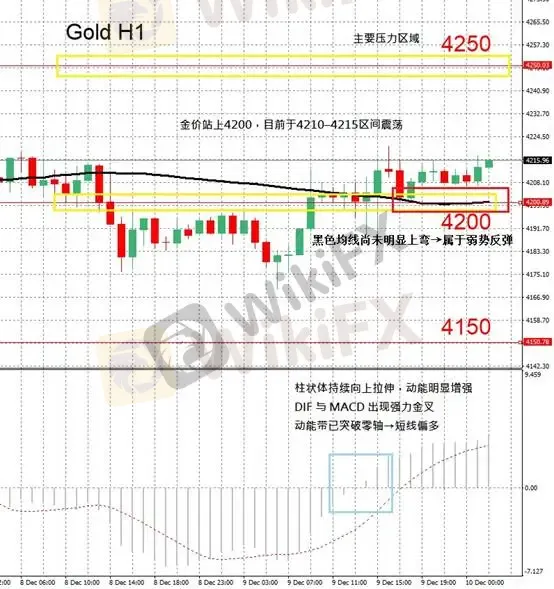
Ahead of this weeks U.S. inflation release and the FOMC meeting, gold prices continue to trade in a choppy consolidation pattern, repeatedly oscillating within the $4,200–$4,250 range as markets grapple with a clear tug-of-war between bulls and bears.
H1 Trend Overview
Gold has successfully reclaimed the $4,200 level and is currently consolidating between $4,210–$4,215.
The black moving average has yet to meaningfully turn upward → this indicates a weak rebound, not a confirmed trend reversal.
Major resistance remains at $4,250; a decisive break above this zone is required to shift the structure into a true bullish trend.
Risk Disclaimer
The views, analysis, research, price levels, or other information provided above constitute general market commentary and do not represent the official position of this platform. All readers should evaluate their own risk tolerance and exercise caution in trading.
Disclaimer:
Le opinioni di questo articolo rappresentano solo le opinioni personali dell’autore e non costituiscono consulenza in materia di investimenti per questa piattaforma. La piattaforma non garantisce l’accuratezza, la completezza e la tempestività delle informazioni relative all’articolo, né è responsabile delle perdite causate dall’uso o dall’affidamento delle informazioni relative all’articolo.
WikiFX Trader
fpmarkets
Sotto supervisione
IC Markets Global
Sotto supervisione
HFM
Sotto supervisione
Exness
Sotto supervisione
AVATRADE
Sotto supervisione
FXTM
Sotto supervisione
fpmarkets
Sotto supervisione
IC Markets Global
Sotto supervisione
HFM
Sotto supervisione
Exness
Sotto supervisione
AVATRADE
Sotto supervisione
FXTM
Sotto supervisione
WikiFX Trader
fpmarkets
Sotto supervisione
IC Markets Global
Sotto supervisione
HFM
Sotto supervisione
Exness
Sotto supervisione
AVATRADE
Sotto supervisione
FXTM
Sotto supervisione
fpmarkets
Sotto supervisione
IC Markets Global
Sotto supervisione
HFM
Sotto supervisione
Exness
Sotto supervisione
AVATRADE
Sotto supervisione
FXTM
Sotto supervisione
Rate Calc
USD

CNY
Tasso di cambio attuale:0
inserisci l'importo
USD
A disposizione
CNY
Calcolare